Ridge Vent vs Box Vent vs Turbine
Choosing the right attic ventilation system can feel like trying to solve a complicated puzzle, especially when you're faced with terms like "ridge vent," "box vent," and "turbine vent." It’s a common frustration to know that proper ventilation is crucial for your roof’s longevity and your home’s comfort, but not understand the fundamental differences or which option is truly best for your specific situation. This guide is here to untangle that confusion, breaking down each ventilation type, comparing their effectiveness, aesthetics, and costs, so you can make an informed decision for your asphalt roofing system.
Understanding the Importance of Attic Ventilation
Before we dive into the specifics of different vent types, let's take a moment to really understand why attic ventilation isn't just a "nice-to-have" but an absolute necessity for the health of your home and roof. Many homeowners overlook this critical component, often until problems start to crop up.
Why Your Attic Needs to Breathe
Think of your attic as your home's lungs. Just like your own lungs need to take in fresh air and expel stale air to function properly, your attic needs a constant flow of air. This movement of air, known as passive ventilation or sometimes active ventilation depending on the system, is essential for a couple of key reasons. In the summer, your attic can become an oven, with temperatures soaring to 150 degrees Fahrenheit or even higher on a hot day. This intense heat can literally bake your shingles from the underside, accelerating their aging process and leading to premature failure. Hot air trapped in the attic also radiates down into your living space, making your air conditioner work overtime and driving up your energy bills.
Conversely, in colder months, warm, moist air from your home can rise into the attic. Without proper ventilation, this moisture gets trapped and condenses on cooler surfaces like the underside of your roof deck. This can lead to serious issues like mold and mildew growth, which are not only unhealthy but can also compromise the structural integrity of your roof decking over time. Adequate ventilation helps carry this moist air out, preventing condensation and its damaging effects. Essentially, a well-ventilated attic helps regulate temperature and manage moisture, protecting your roof and making your home more comfortable year-round. If you're wondering How Roof Ventilation Works, it's a constant cycle of bringing in cooler, drier air and expelling hotter, moister air.
Common Problems from Poor Ventilation
The consequences of insufficient attic ventilation are far-reaching and can be quite costly to remedy. One of the most immediate signs is often seen on your energy bills; that feeling that your AC is running constantly but your house still feels stuffy in the summer is a strong indicator. Beyond that, the physical damage to your roof system can be severe.
Premature shingle aging is a huge concern. When shingles are exposed to extreme heat from above (the sun) and below (trapped attic heat), they can curl, crack, and lose their protective granules much faster than they should. This granule loss not only impacts the aesthetics of your roof but also reduces its ability to reflect UV rays and protect the asphalt beneath. You might also notice a phenomenon called "nail pops," where the nails securing your shingles push up due to the expansion and contraction of the roof decking caused by extreme temperature fluctuations. This can create small holes for water intrusion. Furthermore, in cold climates, poor ventilation can contribute significantly to ice dam formation. Ice dams occur when heat escapes from your attic, melts snow on the roof, and the water then refreezes at the colder eaves, creating a barrier that prevents meltwater from draining off the roof. This trapped water can then back up under your shingles and into your home, causing leaks and extensive interior damage. These are all clear Signs You Need a New Roof or at least a significant repair.
The Role of a Complete Roofing System
It’s crucial to understand that attic ventilation isn't a standalone component; it's an integral part of a larger, interconnected "complete roofing system." Modern asphalt roofing manufacturers, like GAF, Owens Corning, and CertainTeed, emphasize the importance of using all components together to achieve optimal performance and warranty coverage. This system typically includes not just the shingles themselves, but also an underlayment, starter strips, hip and ridge caps, and, critically, a balanced intake and exhaust ventilation system.
Intake vents, usually located in the soffits (the underside of your roof's eaves), allow cooler, fresh air to enter the attic. Exhaust vents, which are the ridge, box, or turbine vents we'll discuss today, allow the hot, stale air to escape at or near the peak of the roof. For the system to work efficiently, the amount of intake ventilation must be roughly equal to or slightly greater than the amount of exhaust ventilation. If you have plenty of exhaust but insufficient intake, you'll simply be sucking air from other parts of the house, potentially pulling conditioned air from your living space or even creating negative pressure that draws in harmful combustion gases from appliances. Many manufacturers will only honor their full, extended warranties if a complete system, including proper ventilation, has been installed according to their specifications. This highlights that while individual components are important, their synergistic function is what truly protects your home.
Deep Dive into Ridge Vents
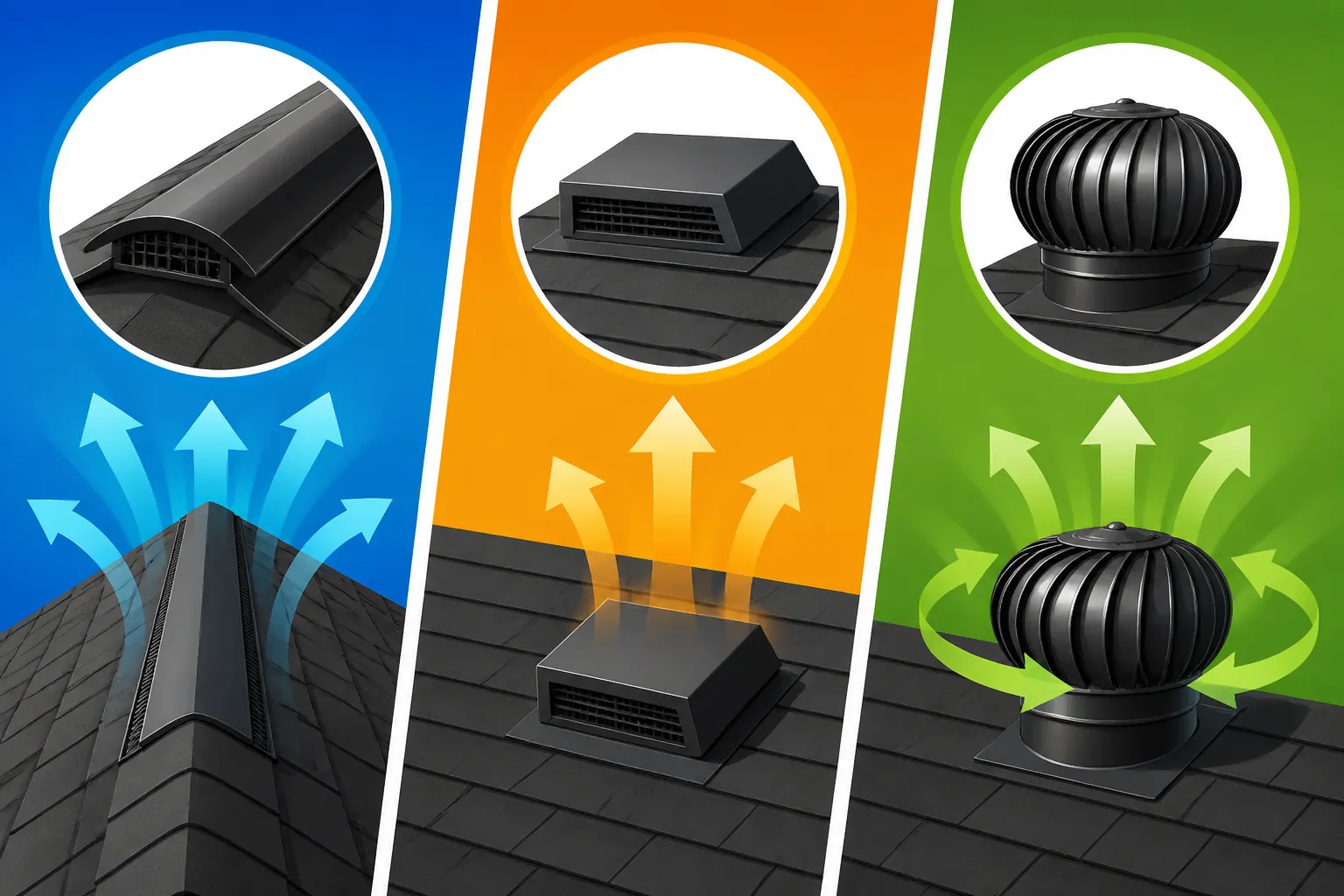
Ridge vents are often hailed as the "gold standard" in attic ventilation, especially for their discreet appearance and continuous airflow. They are designed to blend seamlessly with the roofline, providing an almost invisible solution to attic heat and moisture.
How Ridge Vents Work
Ridge vents operate on the principle of convection, often called the "stack effect." Hot air naturally rises. In an attic with a ridge vent, cooler air enters through the soffit vents at the eaves, travels up through the attic space, and then, as it heats up, rises and exits through the continuous opening at the roof's peak. This constant movement creates a steady current of air that flushes out heat and moisture.
A well-designed ridge vent system typically includes an external baffled design, which means it has internal structures that prevent rain, snow, and insects from entering while still allowing air to escape. Some models also incorporate a filter to keep out dust and debris. The placement of a ridge vent along the entire ridge line ensures that exhaust ventilation is distributed evenly across the highest point of the roof, where heat naturally accumulates. This continuous, uniform ventilation is a major advantage, as it minimizes dead air spots where heat and moisture could otherwise build up. It’s a very elegant solution that capitalizes on natural air movement.
Types of Ridge Vents and Installation
There are a few variations of ridge vents, but they generally fall into two main categories: shingle-over and aluminum/plastic models.
- Shingle-Over Ridge Vents: These are the most popular type today. They are designed to be covered with standard roof shingles or special cap shingles, making them virtually invisible from the ground. This is a huge win for homeowners concerned about aesthetics. They often come in rolls or 4-foot sections made from a high-density, weather-resistant plastic or fiberglass material. Installation involves cutting a slot along the ridge of the roof, sealing it, and then fastening the vent material over the opening, finally capping it with hip and ridge shingles. This method creates a sleek, integrated look.
- External Ridge Vents: These are typically made from aluminum or rigid plastic and are installed on top of the ridge, without being covered by shingles. While still functional, they are more noticeable than their shingle-over counterparts. They're less common in new residential construction now due to aesthetic preferences but can be found in some older homes or certain commercial applications.
Proper installation is paramount for any ridge vent system. The roofer must ensure a continuous, unobstructed opening along the ridge, apply appropriate underlayment and sealants, and secure the vent properly to prevent blow-offs during high winds. The Cost of Ridge Vent Installation can vary, but generally reflects the precision and materials needed for this integrated approach. A reputable contractor will also ensure that intake vents are sufficient to match the exhaust capacity of the ridge vent.
Pros and Cons of Ridge Vents
Like any roofing component, ridge vents come with their own set of advantages and disadvantages.
Pros:
- Excellent Performance: When paired with adequate soffit intake, ridge vents offer continuous, uniform airflow across the entire attic space, making them highly effective at removing heat and moisture.
- Superior Aesthetics: Especially the shingle-over varieties, they blend seamlessly with the roofline, preserving the aesthetic appeal of your home. This is often a deciding factor for homeowners who value curb appeal.
- Low Maintenance: With no moving parts, ridge vents are generally very durable and require minimal maintenance once installed correctly. They are less prone to issues like rattling or breaking than mechanical vents.
- Energy Efficiency: By maintaining consistent attic temperatures, ridge vents help reduce the load on your HVAC system, leading to lower energy bills.
- Enhanced Warranty Potential: Many roofing manufacturers specify the use of a balanced ridge and soffit vent system for their best warranties, emphasizing their effectiveness.
Cons:
- Requires a Ridge: Obviously, for a ridge vent to be installed, your roof must have a ridge line. Not suitable for flat roofs or homes with complex roof designs that lack significant ridge lengths.
- Dependent on Soffit Vents: Their effectiveness is entirely reliant on having proper, unobstructed soffit intake vents. Without adequate intake, they cannot function efficiently.
- Higher Initial Cost: Installation can sometimes be more involved and thus slightly more expensive than simple box vents due to the continuous opening cut and careful shingle integration.
- Wind-Driven Rain/Snow Risk (Minimal): While baffled designs greatly mitigate this, in extreme wind-driven rain or very fine blowing snow, there's a minor theoretical risk of moisture intrusion if not installed perfectly or if the vent quality is poor.
Overall, ridge vents are a top choice for many homeowners and contractors, offering a powerful combination of efficiency and discreet design.
Exploring Box Vents Static Vents
Box vents, also known as static vents or louvered vents, are a more traditional and often more budget-friendly option for attic ventilation. They are distinct in their appearance and function compared to the continuous flow of a ridge vent or the dynamic nature of a turbine vent.
What Are Box Vents and How They Function
Box vents are essentially passive exhaust vents that sit directly on the roof surface, typically near the peak. They are usually rectangular or square, made of metal or plastic, and have louvers (slats) that allow air to escape while providing some protection against rain and snow. Unlike ridge vents that use the entire ridge line, box vents are individual units.
Their function relies on a combination of convection (hot air rising) and positive/negative pressure differences caused by wind blowing over the roof. As hot air builds up in the attic, it rises and seeks an exit through the nearest box vent. When wind blows across the roof, it can create a slight negative pressure over the vent openings, helping to pull air out. However, their reliance on these somewhat sporadic forces means they don't provide the continuous, uniform airflow of a ridge vent system. They are "static" because they have no moving parts and don't actively pull air like a turbine. This makes them a simple, straightforward option, but one that often requires more units to achieve adequate ventilation.
Placement and Number of Box Vents
The effective placement and the correct number of box vents are crucial for their performance. Because they are individual units, you generally need multiple box vents spread across the upper slopes of the roof to adequately ventilate the attic space. A common recommendation is one box vent for every 300 square feet of attic floor space, assuming you also have proper soffit intake. However, this is just a general guideline, and the specific number will depend on factors like your roof pitch, climate, and the amount of existing intake ventilation.
Box vents are typically installed on the upper third of the roof, close to the ridge but not directly on it. This allows them to capture the rising hot air most effectively. If a roof has multiple, disconnected attic spaces or complex angles, box vents can be a flexible solution, as they can be strategically placed to target specific areas that a continuous ridge vent might not reach. For instance, a home with a large, sprawling attic might benefit from a combination of ridge and box vents, or multiple box vents if the ridge line is interrupted by dormers or other features. This modular approach can be appealing for certain roof designs.
Advantages and Disadvantages of Box Vents
Box vents offer a tried-and-true method of attic ventilation, but they come with their own set of trade-offs.
Pros:
- Cost-Effective: Generally, box vents have a lower material cost and can be quicker to install than ridge vents, making them a more budget-friendly option upfront.
- Simple Installation: Their installation process is relatively straightforward, involving cutting an opening in the roof deck, sealing, and fastening the vent. This can reduce labor costs.
- Durability: With no moving parts, they are very durable and require virtually no maintenance. They aren't prone to mechanical failures or rattling.
- Targeted Ventilation: They can be useful for ventilating isolated attic spaces, small roofs, or areas where a continuous ridge vent isn't feasible due to roof design.
- Good for Smaller Roofs: For smaller homes or garages, a few strategically placed box vents can provide sufficient airflow.
Cons:
- Less Aesthetic Appeal: Box vents are visible on the roof surface, interrupting the clean lines of the shingles. Many homeowners find them less appealing than the hidden ridge vent.
- Less Efficient Airflow: They provide spot ventilation rather than continuous, uniform airflow. This can lead to "dead spots" in the attic where heat and moisture still accumulate, especially on larger or more complex roofs.
- More Penetrations: To achieve adequate ventilation, you'll need to install multiple units, which means more penetrations in your roof. Every penetration is a potential point of failure for leaks, though proper flashing minimizes this risk.
- Reliance on Wind/Convection: Their effectiveness relies heavily on natural convection and favorable wind conditions. On still, hot days, their performance can be limited.
- Potential for Snow/Rain Intrusion: While designed with louvers, in extreme conditions, heavy wind-driven rain or fine blowing snow can potentially enter the attic, though this is rare with quality products and proper installation.
Despite their drawbacks in aesthetics and uniform performance compared to ridge vents, box vents remain a viable and economical choice for many homes, especially when budget is a primary concern or specific roof geometries make other options difficult.
Unpacking Turbine Vents Whirlybirds
Turbine vents, affectionately known as "whirlybirds" for their distinct rotating heads, represent an interesting middle ground in the world of attic exhaust ventilation. They offer a more active approach to ventilation compared to static box vents, leveraging wind to create powerful airflow.
How Turbine Vents Harness Wind Power
Turbine vents are cylindrical, dome-shaped vents with fins or blades that sit on a central shaft. They are designed to rotate freely when wind blows across them. As the turbine spins, it creates a powerful centrifugal force that draws hot, stale air out of the attic. The faster the wind blows, the faster the turbine spins, and the more air it exhausts. This makes them a more "active" form of passive ventilation than static box vents, as they actively pull air rather than just allowing it to escape by convection.
Even on days with very light breezes, a well-maintained turbine can often generate enough rotation to create a noticeable vacuum, effectively ventilating the attic. This ability to harness wind energy makes them quite efficient in windy regions, providing robust exhaust where other passive options might struggle without a strong stack effect. However, their performance is directly proportional to wind speed – on perfectly still days, they revert to functioning much like a static box vent, relying solely on natural convection.
Turbine Vent Variations and Performance
While the basic concept remains the same, there are some variations in turbine vents.
- Material: Most are made from aluminum, which is lightweight and rust-resistant, but you can also find plastic versions. The quality of the bearings in the shaft is crucial for long-term, quiet operation.
- Size: They come in various diameters, typically ranging from 12 to 14 inches. Larger turbines generally move more air.
- Design: Some modern designs may incorporate more aerodynamic fins or different bearing systems to improve efficiency and reduce noise.
In terms of performance, turbine vents can be very effective, often moving more cubic feet per minute (CFM) of air than a single box vent. Their efficiency is directly tied to local wind conditions. For instance, a home in a naturally breezy area like coastal Florida or windy plains states such as Oklahoma might find turbine vents to be exceptionally effective. However, a home nestled in a sheltered valley with minimal wind might not experience the full benefit. It’s a classic case of evaluating your specific environmental factors. The goal, similar to other vents, is to achieve a balanced system with adequate intake from Soffit and Fascia Explained to maximize their exhaust capabilities.
Benefits and Drawbacks of Turbine Vents
Turbine vents certainly have their proponents, particularly in certain climates, but they also come with considerations.
Pros:
- High Exhaust Capacity: When the wind is blowing, turbine vents can exhaust a significant volume of hot air from the attic, often more than a static box vent.
- Active Air Movement: They actively pull air out of the attic, which can be more effective than passive convection alone, especially in situations where the stack effect is weak.
- Cost-Effective (Mid-Range): Their initial cost is often higher than basic box vents but can be comparable to or less than a full ridge vent system, depending on the number of units needed.
- Energy Savings: By effectively removing hot air, they can reduce cooling costs during warmer months.
Cons:
- Aesthetics: Like box vents, turbine vents are visible on the roof, and their spinning nature can be a visual distraction for some homeowners, impacting curb appeal.
- Moving Parts and Maintenance: The bearings can wear out over time, leading to squeaking, rattling, or seizing up. This means they require more maintenance than static vents and have a shorter lifespan for their moving parts.
- Wind Dependent: On calm days, their performance is significantly reduced, effectively becoming static vents. They are not as consistently effective as a well-designed ridge vent system that relies on natural convection.
- Noise Potential: Older or poorly maintained turbines can become quite noisy, especially in strong winds, which can be irritating.
- Potential for Leaks/Damage: As with any roof penetration, improper installation can lead to leaks. Strong winds can also potentially damage the fins or cause the entire unit to detach if not securely fastened.
Despite the drawbacks, for homes in consistently windy areas or those looking for a relatively active ventilation solution without the higher cost of powered attic fans, turbine vents can be a suitable option.
Comparing the Three: Performance, Aesthetics, and Cost
Now that we’ve explored each type of attic exhaust vent, let’s put them side-by-side to understand their key differences in the aspects that matter most to homeowners: how well they work, how they look, and what they cost. Making an informed decision often boils down to balancing these three critical factors.
Ventilation Efficiency Showdown
When it comes to pure ventilation efficiency, particularly for a large, continuous attic space, the ridge vent often comes out on top. Its continuous opening along the highest point of the roof, when combined with adequate soffit intake, creates a highly consistent and uniform airflow across the entire attic. This continuous "stack effect" minimizes hot spots and ensures maximum heat and moisture removal. It's a passive system that leverages natural principles most effectively.
Turbine vents offer a more dynamic approach. In windy conditions, they can be incredibly efficient, actively pulling a large volume of air out of the attic due to their rotating mechanism. However, their performance fluctuates directly with wind speed. On calm days, they become less effective, essentially performing as a static vent. This variability means their overall efficiency is highly dependent on your local climate and daily weather patterns.
Box vents are the simplest and most static option. They rely primarily on the natural rise of hot air (convection) and incidental wind currents to create airflow. Because they are individual units, you need multiple box vents to cover the attic space, and even then, they can leave "dead air" pockets where heat and moisture accumulate. They are generally considered the least efficient per unit compared to ridge or well-spinning turbine vents for large attics. However, for smaller, simpler attics or isolated areas, they can be sufficient.
The overall effectiveness of any system hinges on a balanced approach – ensuring that intake ventilation (usually through soffit vents) matches or slightly exceeds the exhaust ventilation. Without proper intake, even the most efficient exhaust vent will struggle to pull air, potentially drawing conditioned air from your living space, which is counterproductive. Understanding How Attic Ventilation Prevents Damage requires appreciating this balance.
Visual Impact and Curb Appeal
For many homeowners, how a component looks on their roof is almost as important as how well it functions, especially when considering resale value and pride of ownership. This is where the differences between these three vent types become most pronounced.
Ridge vents, particularly the "shingle-over" variety, are the undisputed champions of aesthetics. Because they are covered with regular roofing shingles, they essentially disappear into the roofline. From the ground, you often can't tell they're even there, preserving the clean, uninterrupted look of your roof. This makes them highly desirable for homes where curb appeal is a significant concern.
Box vents are quite visible. These rectangular or square units sit on top of the roof shingles, creating distinct protrusions. While necessary for ventilation, they do break up the smooth expanse of the roof. Depending on the color and material, they can be somewhat camouflaged, but they will always be noticeable. For some, this isn't a problem, but for others, it can be an eyesore.
Turbine vents are perhaps the most visually distinctive of the three. Their rotating, domed shape makes them stand out significantly on the roof. While some might find the spinning motion visually interesting, others find it distracting or even a bit industrial-looking. They can detract from a home's traditional aesthetic, and their movement can draw unwanted attention, especially if they start to squeak or wobble over time. They are definitely not for homeowners prioritizing an invisible ventilation solution.
Ultimately, the best vent from an aesthetic standpoint often boils down to personal preference, but ridge vents consistently win out for blending in seamlessly with [Asphalt Roofing].
Cost Considerations and Long-Term Value
When budgeting for a new roof or ventilation upgrade, the cost is naturally a major factor. It’s not just about the upfront price, but also the long-term value, including energy savings and potential maintenance. The overall How Much Does an Asphalt Shingle Roof Cost also incorporates these choices.
Box Vents (Static Vents):
- Initial Cost: Generally the least expensive option per unit for materials and installation. A single box vent might cost anywhere from $30-$100 for the unit, plus installation labor. Since you need multiple units, the total cost for a typical roof could range from $300 to $800 for the vents themselves, not including flashing and labor.
- Long-Term Value: Low maintenance due to no moving parts. However, less efficient ventilation might lead to higher energy bills or premature roof aging compared to better systems.
Turbine Vents (Whirlybirds):
- Initial Cost: A bit more expensive than box vents, typically ranging from $50-$200 per unit, plus installation. For a standard home, total material and installation could be $500 to $1,200.
- Long-Term Value: Can offer good energy savings in windy areas. However, they have moving parts (bearings) that can wear out, squeak, and require replacement over their lifespan, adding to long-term costs and potential frustration.
Ridge Vents:
- Initial Cost: Often the most expensive upfront. While the material cost per linear foot might seem reasonable, the total installation can be higher due to the labor involved in cutting the continuous slot, ensuring proper sealing, and integrating the vent seamlessly with the ridge cap shingles. The total cost for a typical home could range from $700 to $1,500 or more, depending on the length of the ridge and roof complexity.
- Long-Term Value: High. Their superior, consistent performance leads to excellent energy efficiency and extends the life of your roof, offering significant long-term savings. They also require very little maintenance and enhance curb appeal, adding to home value. Many homeowners find the slightly higher initial investment worthwhile for these benefits. They also often contribute to fulfilling requirements for premium manufacturer warranties, providing additional peace of mind.
Here's a quick comparison table to summarize:
| Feature | Ridge Vent | Box Vent (Static) | Turbine Vent (Whirlybird) |
|---|---|---|---|
| Aesthetics | Excellent (Blends seamlessly) | Fair (Visible, protrudes) | Poor to Fair (Very visible, rotating, can be distracting) |
| Ventilation Efficiency | Excellent (Continuous, uniform airflow) | Fair (Spot ventilation, relies on convection/light wind) | Good (Active airflow with wind, variable without) |
| Cost (Initial) | Higher | Lower | Mid-range |
| Maintenance | Very Low (No moving parts) | Very Low (No moving parts) | Moderate (Bearings can wear, require occasional replacement) |
| Wind Dependence | Low (Relies on stack effect) | Moderate (Aids convection, but not primary driver) | High (Performance directly correlates with wind speed) |
| Noise Potential | None | None | Low to Moderate (Can squeak/rattle when old or damaged) |
| Roof Penetrations | One continuous slot | Multiple individual penetrations | Multiple individual penetrations |
| Longevity | Very Long (Often matches roof lifespan) | Very Long (Matches roof lifespan) | Moderate (Moving parts wear out) |
It’s important to remember that these are general comparisons. The best choice for your home will depend on specific factors like your climate, roof design, budget, and aesthetic preferences. Getting multiple detailed estimates, like those outlined in How to Read and Compare Roofing Estimates, will help solidify these costs.
Making the Right Choice for Your Home
Deciding on the best attic ventilation system isn't a one-size-fits-all situation. It requires thoughtful consideration of various factors unique to your home and your priorities. Don't rush into a decision; taking the time to understand your options will pay dividends in roof longevity, energy savings, and overall comfort.
Factors to Consider for Your Specific Needs
When evaluating ridge, box, and turbine vents, think about these key elements:
- Roof Design and Pitch: Does your roof have a prominent, continuous ridge line? If so, a ridge vent is often the most effective and aesthetically pleasing choice. If your roof has many hips, complex angles, or is relatively flat, individual box or turbine vents might be more practical for specific sections. Very low-pitch roofs, for example, might struggle with the natural stack effect that ridge vents rely on, making mechanical options more appealing. A professional can help you assess your Roof Pitch and Slope Explained.
- Climate and Wind Patterns: If you live in a region with consistently strong winds, turbine vents can be incredibly effective at actively pulling hot air out. Conversely, in calm, hot climates, a well-balanced ridge vent system, which relies on the natural rise of hot air, might offer more consistent performance. In areas prone to heavy snow, ensure any chosen vent type is designed to prevent snow intrusion. For instance, in colder climates like those in Minnesota, proper ventilation is critical for preventing ice dams.
- Aesthetic Preferences and Curb Appeal: This is often a significant deciding factor. If a seamless, clean roofline is important to you, a shingle-over ridge vent is the clear winner. If you're less concerned about visible protrusions and prioritize budget or specific functionality, box or turbine vents could be suitable.
- Budget: While ridge vents typically have a higher upfront cost, their long-term benefits in terms of energy savings and roof longevity can often justify the investment. Box vents are usually the most budget-friendly initial option, and turbines fall somewhere in the middle. Think about the total Roof Cost Per Square including all components, not just the shingles.
- Existing Ventilation: Do you have existing soffit intake vents? Are they clear and unobstructed? Any exhaust system, regardless of type, will be ineffective without adequate intake. A roofing professional can inspect your current setup and recommend a balanced system.
- Noise Tolerance: If you value quiet, a ridge vent or box vent is ideal as they have no moving parts. Turbine vents, especially older or poorly maintained ones, can sometimes produce noise, particularly in high winds.
Consulting with a Roofing Professional
The absolute best way to make an informed decision is to consult with experienced, reputable roofing contractors. They can perform a thorough inspection of your attic and roof, taking into account all the factors mentioned above, as well as local building codes and climate considerations. A good contractor won't just tell you what they install; they'll explain why a particular system would work best for your home.
Ask them to provide detailed explanations for their recommendations, including the projected CFM (cubic feet per minute) of airflow for their proposed system and how it balances with your intake ventilation. Don't hesitate to ask Questions to Ask a Roofing Contractor Before Hiring. They should be able to clearly articulate the pros and cons of each option relative to your specific situation and provide a transparent breakdown of costs. Look for contractors who are certified by major shingle manufacturers like GAF, Owens Corning, or CertainTeed, as these certifications often indicate a higher level of training and adherence to best practices. Firms that prioritize customer education, like those partnered with services such as Modernize, are often a good starting point for finding reliable expertise. Remember, choosing a contractor isn't just about the lowest bid; it's about finding a partner who will ensure your entire roofing system, including ventilation, is installed correctly and efficiently. You'll want to avoid Roofing Contractor Red Flags to Avoid at all costs.
The Importance of a Balanced System
We cannot stress this enough: any exhaust ventilation system, whether it’s a ridge vent, box vent, or turbine vent, relies entirely on a properly balanced intake system. Without adequate intake, typically through continuous soffit vents, gable vents, or even specialized undereave vents, your exhaust vents simply cannot perform their job effectively.
Imagine trying to suck air out of a sealed bottle. You might create a vacuum, but very little air will actually move. Your attic is similar. If you're constantly pulling hot, moist air out through exhaust vents but aren't allowing an equal amount of cooler, drier air to enter at the lowest points, your system is unbalanced. This leads to inefficient ventilation, where you might only be drawing air from a small area around the exhaust vents, or worse, pulling conditioned air from inside your home. An unbalanced system can lead to prematurely failing shingles, higher energy bills, and even create negative pressure that can backdraft combustion appliances. When you hire a professional for your roof replacement or ventilation upgrade, they should always address both the intake and exhaust components to create a truly effective and energy-efficient roofing system. This comprehensive approach is part of How a Roof Replacement Works: The Full Process to ensure your new roof lasts as long as it should.
Disclaimer
Please remember that the information provided in this guide is for general informational purposes only and does not constitute professional advice. Roofing work can be complex and dangerous. Always consult with a qualified and licensed roofing contractor for specific recommendations, estimates, and safe installation practices for your individual property. Local building codes and regulations may vary and should always be followed.