How Attic Ventilation Prevents Damage
It’s a common scenario: you walk into your attic on a sweltering summer day, and it feels like an oven. Or perhaps you’ve noticed stubborn ice dams clinging to your eaves during winter, causing a persistent drip. These aren't just minor annoyances; they're often red flags pointing to a critical, often overlooked issue: inadequate attic ventilation. A poorly ventilated attic can silently wreak havoc on your home, leading to everything from sky-high energy bills to serious structural damage and premature roof failure. This comprehensive guide will walk you through exactly how proper attic ventilation acts as your home's unseen guardian, preventing costly and frustrating damage year-round.
The Silent Threats Lurking in Your Attic
Your attic, often out of sight and out of mind, is a vital part of your home's ecosystem. When it's not properly ventilated, it becomes a hotbed for problems that can quietly undermine your home's integrity and your comfort. Understanding these threats is the first step toward appreciating the power of proper airflow.
Heat Buildup and Energy Waste
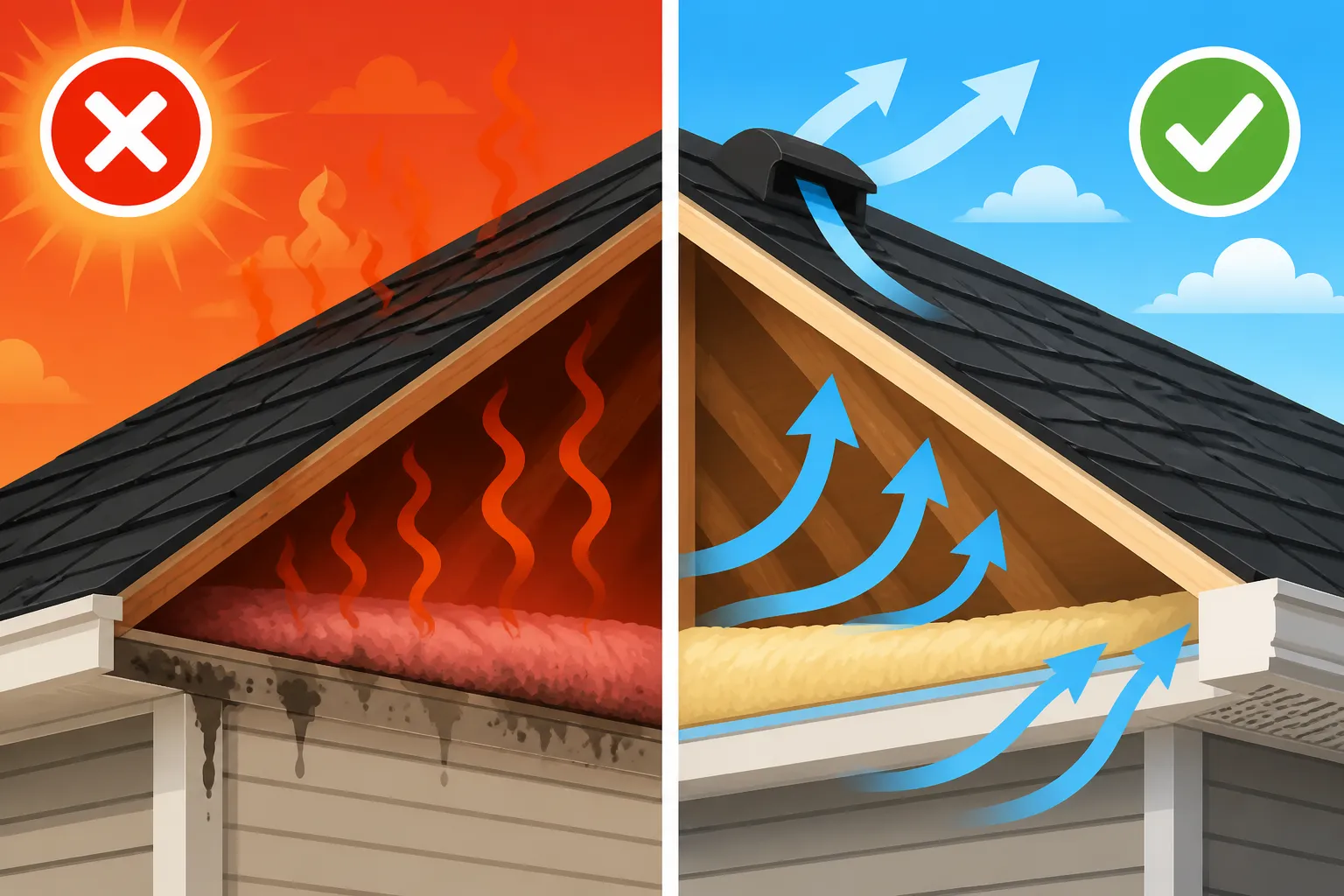
Imagine your attic without proper ventilation as a giant heat trap. On a sunny day, the sun beats down on your roof, and that heat radiates directly into your attic space. Without a way for this hot air to escape and cooler air to enter, temperatures can soar to 150 degrees Fahrenheit or even higher. This isn't just uncomfortable; it's a huge energy drain.
This trapped heat radiates downwards into your living spaces, forcing your air conditioner to work overtime to keep your home cool. You might find yourself cranking the thermostat lower and lower, yet still feeling muggy, all while watching your electricity bills climb higher and higher. It’s a frustrating cycle that many homeowners experience, often unaware that the root cause is right above their heads. This constant battle against excessive heat puts undue stress on your HVAC system, potentially shortening its lifespan and leading to expensive repairs down the line.
Moisture, Mold, and Rot
Heat isn't the only enemy in an unventilated attic; moisture is just as insidious. Everyday activities like showering, cooking, and even breathing generate moisture inside your home. This warm, humid air naturally rises, eventually making its way into the attic. If there's no way for this moisture-laden air to escape, it condenses on cooler surfaces like roof sheathing, rafters, and insulation, especially during colder months.
This condensation creates a perfect breeding ground for mold and mildew, which can quickly spread, compromising air quality and potentially causing health issues for your family. Beyond mold, persistent moisture can lead to wood rot, weakening the structural components of your roof deck and attic framework. This kind of damage can be incredibly expensive to repair, often requiring extensive demolition and reconstruction once it's identified. A proactive approach with good ventilation prevents these moisture nightmares before they even begin.
Premature Shingle Deterioration
It might surprise you, but the lifespan of your asphalt shingles is directly tied to how well your attic is ventilated. The intense heat trapped in a poorly vented attic essentially "cooks" your shingles from the underside. This accelerates the breakdown of the asphalt, causing the granular surface to loosen and fall off prematurely.
You might notice excessive granule loss in your gutters or a dull, worn appearance on your roof long before it should be showing its age. This rapid deterioration not only detracts from your home's curb appeal but also significantly reduces the protective capabilities of your roofing materials. The shingles become brittle, more susceptible to cracking, curling, and wind damage, ultimately leading to a much shorter service life than the manufacturer intended. This means you’ll be looking at a costly roof replacement much sooner than you anticipated, simply because the hot air couldn't escape. Understanding how long an asphalt roof lasts often hinges on this very factor.
Understanding the Core Principles of Attic Ventilation
Proper attic ventilation isn't just about sticking a few vents on your roof and calling it a day. It's about creating a balanced, continuous flow of air that works with natural physics to keep your attic healthy. This isn't magic; it's a well-designed system leveraging fundamental principles.
The Stack Effect in Action
The "stack effect," also known as the "chimney effect" or "convection," is the driving force behind effective attic ventilation. It's the natural phenomenon where warm air rises and cooler air sinks. In your home, hot, stale air in the attic, being less dense, wants to rise and escape through exhaust vents positioned near the roof's peak.
As this warm air exits, it creates a slight negative pressure, which then draws in cooler, fresh air through intake vents located lower on the roof, typically along the eaves or soffits. This continuous movement of air, from low to high, is the essence of a passive ventilation system. It doesn't require electricity or moving parts; it simply harnesses the power of temperature differences to keep the air circulating, preventing heat and moisture from stagnating.
Balanced Airflow: Intake and Exhaust
For the stack effect to work efficiently, you absolutely need a balanced ventilation system. This means having an adequate amount of both intake vents and exhaust vents. Think of it like a lung: you need to be able to breathe in (intake) and breathe out (exhaust) freely. If you have plenty of exhaust vents but no way for fresh air to enter, your attic will struggle to "breathe." Similarly, if you only have intake vents, the hot air won't have a clear path to escape.
An ideal system aims for roughly a 50/50 split between intake and exhaust capacity. This ensures that for every cubic foot of hot air that leaves your attic, a cubic foot of cooler, drier air replaces it. Without this balance, you can create dead air pockets where heat and moisture can still accumulate, or worse, inadvertently draw conditioned air from your living space into the attic, which is counterproductive. Many homeowners struggle with knowing how roof ventilation works, but this balanced approach is key.
Convection and Air Movement
The principle of convection dictates that hot air rises, and cool air sinks. In the context of your attic, this means the hottest air naturally collects at the highest points of your attic space, directly under the roof deck. A well-designed ventilation system capitalizes on this natural tendency.
Intake vents, such as those found in your soffits, allow cooler, ambient outside air to enter the attic at its lowest points. As this cooler air warms up from the radiant heat of the roof, it begins to rise, pushing the already hot, stale air upwards towards the exhaust vents at the ridge or other high points of the roof. This continuous convective loop helps scour the entire attic space, removing heat and moisture before they can cause damage. Without this constant air exchange, the air simply sits stagnant, allowing moisture to condense and temperatures to climb unchecked.
Key Components of an Effective Ventilation System
Understanding the principles is one thing, but knowing the actual parts of the system is what allows you to ensure your home is protected. An effective attic ventilation system is a symphony of components working together.
Intake Vents: Soffit and Gable
Intake vents are the unsung heroes of attic ventilation, often overlooked but absolutely essential. These are the entry points for the cooler, outside air that needs to enter your attic. The most common types are:
- Soffit Vents: These are installed in the soffit, the underside of your roof's overhang. They are usually continuous strips or individual circular vents that run along the entire perimeter of your eaves. Soffit vents are highly effective because they introduce fresh air at the lowest point of the attic, allowing it to naturally rise as it warms up. Crucially, they should be unobstructed by insulation inside the attic; baffles are often installed to maintain a clear air channel. If you're wondering what soffit and fascia explained means for your home, proper soffit venting is a big part of it.
- Gable Vents: These are decorative vents typically located in the triangular wall at the end of a gable roof. While they do provide some airflow, they aren't as efficient as soffit and ridge vent systems for whole-attic ventilation because they often create cross-ventilation in only one part of the attic, leaving other areas stagnant. They can sometimes work against a balanced system if combined with ridge vents, disrupting the natural stack effect. In some cases, they can even pull air from one side and exhaust it out the other, bypassing the rest of the attic entirely.
It's vital that your intake vents have enough net free area (NFA) to match your exhaust vents. Without sufficient intake, your exhaust vents will essentially "starve" for air, limiting their effectiveness.
Exhaust Vents: Ridge, Box, and Turbine
Exhaust vents are where the hot, stale, moisture-laden air finally escapes your attic. They are typically located at or near the highest point of your roof to take full advantage of the stack effect.
- Ridge Vents: These are considered by many to be the most efficient and aesthetically pleasing exhaust option. A continuous ridge vent runs along the entire peak of your roof, providing an uninterrupted opening for hot air to escape. When paired with continuous soffit vents, they create a highly effective, balanced system that ensures even air distribution throughout the attic. They are low profile, blending seamlessly with your roofline, and are often covered with a shingle cap for a finished look.
- Box Vents (Static Vents): These are individual, non-mechanical vents that sit on the roof surface. They rely solely on the natural convection of rising hot air to expel it. While they offer good exhaust in their immediate vicinity, you often need several strategically placed box vents to adequately ventilate a larger attic, which can break up the roof's aesthetic. They are often less efficient than ridge vents for comprehensive, balanced airflow across the entire attic.
- Turbine Vents (Whirlybirds): These are distinctive, spinning vents that use wind power to draw air out of the attic. While they can be quite effective on windy days, their performance is inconsistent, depending entirely on wind conditions. On calm days, they act similarly to static box vents. They are often visible from the ground and can be a significant aesthetic feature on your roof.
It’s generally recommended not to mix different types of exhaust vents, especially turbine or gable vents with ridge vents, as this can disrupt the intended airflow pattern and lead to short-circuiting where air is pulled from one exhaust vent to another instead of through the attic space. For a deep dive, check out our article on Ridge Vent vs Box Vent vs Turbine.
Beyond Vents: Understanding Underlayment and Insulation
While vents are crucial, they aren't the only players in attic climate control. Two other components work hand-in-hand with ventilation to protect your home:
- Underlayment: Installed directly on your roof decking before shingles, the underlayment acts as a secondary barrier against moisture intrusion. Even with perfect ventilation, a severe storm or ice dam could potentially bypass shingles. A high-quality underlayment, like synthetic options, provides an extra layer of protection, preventing water from reaching your attic and home interior. It's not directly part of the ventilation system, but it's a critical backup for moisture management. Our guide on Underlayment Explained: Synthetic vs Felt dives into the details.
- Insulation: Attic insulation is designed to keep conditioned air in your living spaces and unconditioned air (hot or cold) out. It forms a thermal barrier between your attic and your home. However, it's absolutely vital that insulation does not block your intake vents. If insulation covers the soffit vents, you effectively cut off the fresh air supply to your attic, rendering your exhaust vents almost useless. That's why insulation baffles are often installed to hold the insulation back, maintaining a clear channel for air to flow from the soffits up into the attic space. A well-insulated and well-ventilated attic works together to minimize heat transfer, keeping your home comfortable and energy-efficient.
The Year-Round Benefits of Proper Attic Airflow
The advantages of a properly ventilated attic extend far beyond just summer comfort. It's an investment that pays dividends in every season, protecting your home and your wallet throughout the year.
Lowering Energy Bills in Summer
This is often the most immediate and noticeable benefit for homeowners. During the hot summer months, a poorly ventilated attic acts like a giant radiator, transferring heat into your living spaces. Your air conditioner then has to work harder and longer to combat this radiant heat gain, leading to higher electricity consumption and inflated utility bills.
With an effective ventilation system, that superheated air has a clear escape route. As hot air rises and exits through the exhaust vents, it draws in cooler ambient air from the outside through the intake vents. This continuous exchange keeps the attic temperature much closer to the outdoor temperature, sometimes reducing it by as much as 30-40 degrees Fahrenheit compared to an unvented attic. This significant temperature differential means your AC unit doesn't have to strain nearly as much, leading to noticeable savings on your monthly energy statements. It's one of the best ways to ensure efficient home operation and keep a cool, comfortable environment without breaking the bank. Many savvy homeowners utilize resources like Modernize to connect with contractors who can assess and optimize their attic ventilation for energy savings.
Preventing Ice Dams in Winter
While the summer benefits are obvious, proper attic ventilation is equally, if not more, critical during colder months, especially in regions prone to heavy snow and freezing temperatures, like parts of Minnesota or the Northeast. One of the most destructive winter phenomena is the formation of ice dams.
Ice dams occur when heat from your home escapes into the attic, warms the roof deck, and melts snow on the upper portions of the roof. This meltwater then runs down to the colder eaves, where it refreezes, creating a ridge of ice. As more snow melts, the water backs up behind this ice dam, seeping under shingles and into your attic, walls, and ceilings, causing extensive water damage, mold growth, and structural issues. Proper attic ventilation prevents ice dams by keeping the attic cold – close to the outdoor temperature. This prevents the snow on your roof from melting prematurely due to heat escaping from your home, ensuring that when it does melt naturally, it flows freely off the roof rather than refreezing into destructive ice dams.
Extending Your Roof's Lifespan
As mentioned earlier, trapped heat can significantly shorten the life of your asphalt shingles. The extreme temperatures in an unventilated attic literally bake the shingles from the underside, causing the asphalt to become brittle, the protective granules to shed prematurely, and the shingles to crack and curl. This accelerated aging means your roof will wear out years before its intended lifespan, requiring a full roof replacement much sooner than anticipated.
By maintaining a consistently cooler and drier attic environment, a good ventilation system ensures your shingles can perform optimally and last for their full intended duration. This preserves the integrity of the asphalt and its protective granules, keeping your roof more resistant to UV damage, wind, and hail. It's a fundamental aspect of roof maintenance that directly impacts your investment. When considering an asphalt roof replacement cost: complete breakdown, factor in how proper ventilation can help you avoid needing one sooner.
Common Ventilation Mistakes and How to Avoid Them
Even with good intentions, homeowners and even some less experienced contractors can make mistakes that compromise the effectiveness of an attic ventilation system. Being aware of these pitfalls can save you a lot of headache and money.
Insufficient Venting
One of the most frequent errors is simply not having enough ventilation. Many older homes might have a few small box vents or passive gable vents, which were considered adequate decades ago but fall short of modern building codes and best practices. Without enough intake and exhaust, your attic won't be able to effectively shed heat and moisture, leading to the problems we've already discussed.
The general rule of thumb for attic ventilation is to have at least 1 square foot of Net Free Area (NFA) for every 150 square feet of attic floor space, when the ventilation is balanced (50% intake, 50% exhaust). If your home has a vapor barrier, this ratio can be relaxed to 1:300. NFA refers to the actual open area through which air can flow, not just the size of the vent opening. A good roofing contractor will calculate this precisely based on your attic's size and roof design. When you’re looking to find a reputable roofer, make sure they perform these crucial calculations.
Blocked Vents
This is an incredibly common and easily preventable mistake. Intake vents, typically located in the soffits, are often inadvertently blocked by insulation. As insulation settles or is blown in, it can completely cover the vent openings, preventing any fresh air from entering the attic.
To prevent this, insulation baffles (also known as rafter vents) should be installed between the rafters, creating a clear channel for air to flow from the soffit vents up into the attic space. These inexpensive plastic or foam inserts ensure that even a thick layer of insulation doesn't impede airflow. Regularly checking your attic, especially after insulation work, to ensure these channels are clear can make a world of difference. You might also find vents blocked by debris like leaves or nests from pests, so occasional exterior checks are also important.
Mixing Vent Types
As tempting as it might be to add a new turbine vent here or a box vent there to try and improve airflow, mixing different types of exhaust vents can actually do more harm than good. For example, if you have a continuous ridge vent – designed to work with soffit intake vents to create a balanced, uniform airflow – and you also have gable vents or static box vents, you can create a "short-circuit."
Instead of the air flowing from the soffits, across the entire attic, and out the ridge, the ridge vent might start pulling air from the gable vents instead of the soffits. This means that large sections of your attic might not be ventilated at all, creating stagnant zones where heat and moisture can still build up. For optimal performance, it's best to stick to one primary type of exhaust ventilation (like a ridge vent) and ensure it's properly balanced with adequate intake. A manufacturer-certified roofer explained how combining different systems can often void warranties due to improper installation methods.
Assessing and Upgrading Your Current Attic Ventilation
If you suspect your attic ventilation isn't up to snuff, or if you're experiencing any of the warning signs, it's time to take action. Understanding how to assess your current system and what options you have for improvement is crucial.
Professional Attic Ventilation Assessment
While you can do some preliminary checks yourself, a comprehensive assessment by a qualified roofing professional is always the best approach. They have the tools and expertise to accurately evaluate your entire roof and attic system. Here's what they'll typically look for:
- Attic Inspection: They'll go into your attic (if accessible) to check for signs of moisture, mold, rot, and proper insulation depth and placement. They'll also verify that insulation isn't blocking your soffit vents and that baffles are correctly installed.
- Roof Exterior Inspection: On the roof, they'll identify all existing intake and exhaust vents, assessing their condition, type, and total Net Free Area (NFA). They'll look for damage, obstructions, or improper installation.
- Calculations: A good contractor will perform calculations based on your attic's square footage and roof pitch to determine the ideal amount of NFA needed for both intake and exhaust. They'll then compare this to your current system to identify any deficiencies.
- Problem Diagnosis: They can pinpoint specific issues like short-circuiting, insufficient airflow, or areas prone to ice dam formation.
A professional assessment will give you a clear picture of your current situation and the best path forward. Platforms like Modernize can help you find local, reputable contractors experienced in ventilation solutions.
DIY Inspection Tips
For the proactive homeowner, there are several things you can check yourself to get a preliminary idea of your attic ventilation health:
- Temperature Check: On a hot, sunny day, carefully go into your attic. If it feels significantly hotter than the outside air (e.g., 120-150°F when it's 90°F outside), you likely have poor ventilation.
- Moisture and Mold: Look for any signs of water stains, mildew, or mold on the underside of your roof deck, rafters, or insulation. Pay close attention to corners, near chimneys, and around vent pipes.
- Blocked Soffits: From inside the attic, look towards your eaves. Can you see light coming in through the soffit vents? If not, insulation might be blocking them. You might need a flashlight to confirm.
- Exterior Vent Check: From the outside, visually inspect your soffit and exhaust vents for obvious obstructions like bird nests, leaves, or debris. Make sure they aren't painted over entirely.
- Shingle Condition: Walk around your home and look at your roof. Are shingles curling, cracking, or showing excessive granule loss, especially on the sunniest slopes? These are often signs of heat damage. If you're unsure how to read and compare roofing estimates, a self-assessment can help you formulate good questions for contractors.
Remember, these are just preliminary checks. If you find any concerning issues, call in a professional for a thorough evaluation.
Choosing the Right Ventilation Solution
Once you understand your attic's specific ventilation needs, you can work with a contractor to choose the best solution. The goal is always a balanced system with adequate intake and exhaust.
- Adding or Enhancing Intake: If your soffits are enclosed or your existing vents are too small, adding continuous soffit vents is often the most effective solution. If your home has a gable roof with no soffits, other intake options like edge vents installed along the fascia may be considered, though less ideal than soffits.
- Upgrading Exhaust Vents:
- Ridge Vents: If your roof has a continuous ridge, converting to a ridge vent system with proper soffit intake is usually the top recommendation for optimal, uniform airflow.
- Power Fans: In some cases, particularly for very large or complex attics, a thermostatically controlled attic fan (electric or solar-powered) might be recommended to supplement passive ventilation. These fans actively pull hot air out, but they still require sufficient intake to operate efficiently.
- Additional Static Vents: If a ridge vent isn't feasible, adding more strategically placed box vents can improve airflow, but careful calculation of NFA is essential to avoid short-circuiting.
- Addressing Obstructions: This includes installing insulation baffles to keep soffit vents clear and ensuring any existing vents are free of debris.
The best solution will always be tailored to your home's specific design, local climate, and existing conditions. The investment in proper attic ventilation is small compared to the potential costs of premature roof replacement, structural rot, or sky-high energy bills. It's a foundational element of a healthy, protected home.
| Ventilation Component | Purpose | Pros | Cons |
|---|---|---|---|
| Soffit Vents | Intake | Provides continuous, low-level fresh air; often hidden | Can be blocked by insulation; requires an overhang |
| Ridge Vent | Exhaust | Excellent, uniform airflow; aesthetically pleasing; continuous | Requires a continuous roof ridge; needs balanced intake |
| Box Vent (Static) | Exhaust | Simple, inexpensive; easy to install | Less efficient than ridge vent; requires multiple for large attics; visible on roof |
| Turbine Vent | Exhaust | Wind-driven exhaust can be powerful | Performance varies with wind; mechanical parts can wear; visible on roof |
| Gable Vent | Intake/Exhaust | Can provide some cross-ventilation; decorative | Often causes short-circuiting with ridge vents; less effective for whole-attic airflow |
| Power Attic Fan | Exhaust | Active exhaust, good for very hot attics | Requires electricity; can pull conditioned air if intake is poor; mechanical failures |
Disclaimer
Please remember that this article provides general information and recommendations. Every home is unique, and roofing and ventilation projects can be complex. We strongly advise consulting with a qualified and licensed roofing professional to assess your specific needs and ensure any work is done safely and according to local building codes. They can provide accurate estimates and tailored advice for your property.