Cost of Roof Ventilation Upgrades
Have you ever walked into your attic on a sweltering summer day and felt like you stepped into an oven? Or perhaps noticed frost collecting on your attic rafters in the dead of winter? These common, frustrating issues often point to one significant problem: inadequate roof ventilation. Without proper airflow, your home can suffer from prematurely aging shingles, higher energy bills, and even structural damage. This guide is here to shed light on the real costs of upgrading your roof ventilation system and why it's a crucial investment for your home's health and your wallet.
Understanding Roof Ventilation and Why It Matters for Your Home
It's easy to overlook what's going on up in your attic, out of sight, out of mind. But the truth is, your attic and roof are a finely tuned system, and ventilation plays a starring role in its performance. Think of your home as breathing; your roof needs to exhale hot, moist air and inhale fresh, cooler air to stay healthy and efficient.
The Hidden Dangers of Poor Attic Ventilation
Many homeowners don't realize the silent damage that poor ventilation inflicts until it's too late. In the summer, an unventilated attic can reach scorching temperatures, sometimes 150 degrees Fahrenheit or more. This extreme heat doesn't just radiate down into your living space, forcing your air conditioner to work overtime and driving up your energy bills. It actively bakes your roof's asphalt shingles, causing them to crack, curl, and degrade much faster than their expected lifespan. We’re talking about shaving years off your roof’s life, potentially leading to a premature need for a full roof replacement.
Beyond the immediate heat, inadequate ventilation traps moisture in your attic during colder months. As warm, moist air from your home rises into the attic and meets cold surfaces, it condenses, creating frost and eventually dripping water. This persistent moisture is a breeding ground for mold and mildew, which can damage your wooden rafters, insulation, and even impact your indoor air quality. Imagine the expensive repairs needed to address mold remediation or replace rotted roof decking. It’s a cascading problem that all starts with a lack of proper airflow.
The Unseen Benefits of a Well-Ventilated Roof System
On the flip side, a properly ventilated attic is like a breath of fresh air for your entire home. It creates a continuous stream of air that pushes out excess heat and moisture, maintaining a more consistent temperature in your attic year-round. This moderation helps keep your energy costs down, as your HVAC system won't have to fight against an attic that's either boiling or freezing. Installing an effective system means your home stays cooler in the summer and reduces the risk of ice dam formation in the winter, which can cause significant damage along your eaves.
Moreover, good ventilation protects your roofing materials. By preventing extreme temperature fluctuations and moisture buildup, your asphalt shingles will last longer, maintaining their integrity and appearance for years to come. This extended lifespan can be a huge financial benefit, pushing back the timeline for a costly roof replacement. A well-ventilated attic also helps preserve your insulation's effectiveness, preventing it from becoming damp and compressed, which would otherwise reduce its R-value and further hike up your heating and cooling costs. It's a fundamental component of a healthy, efficient, and durable roofing system. For a deep dive into the overall mechanics, you might want to learn more about How Roof Ventilation Works.
Types of Roof Ventilation Upgrades and Their Costs
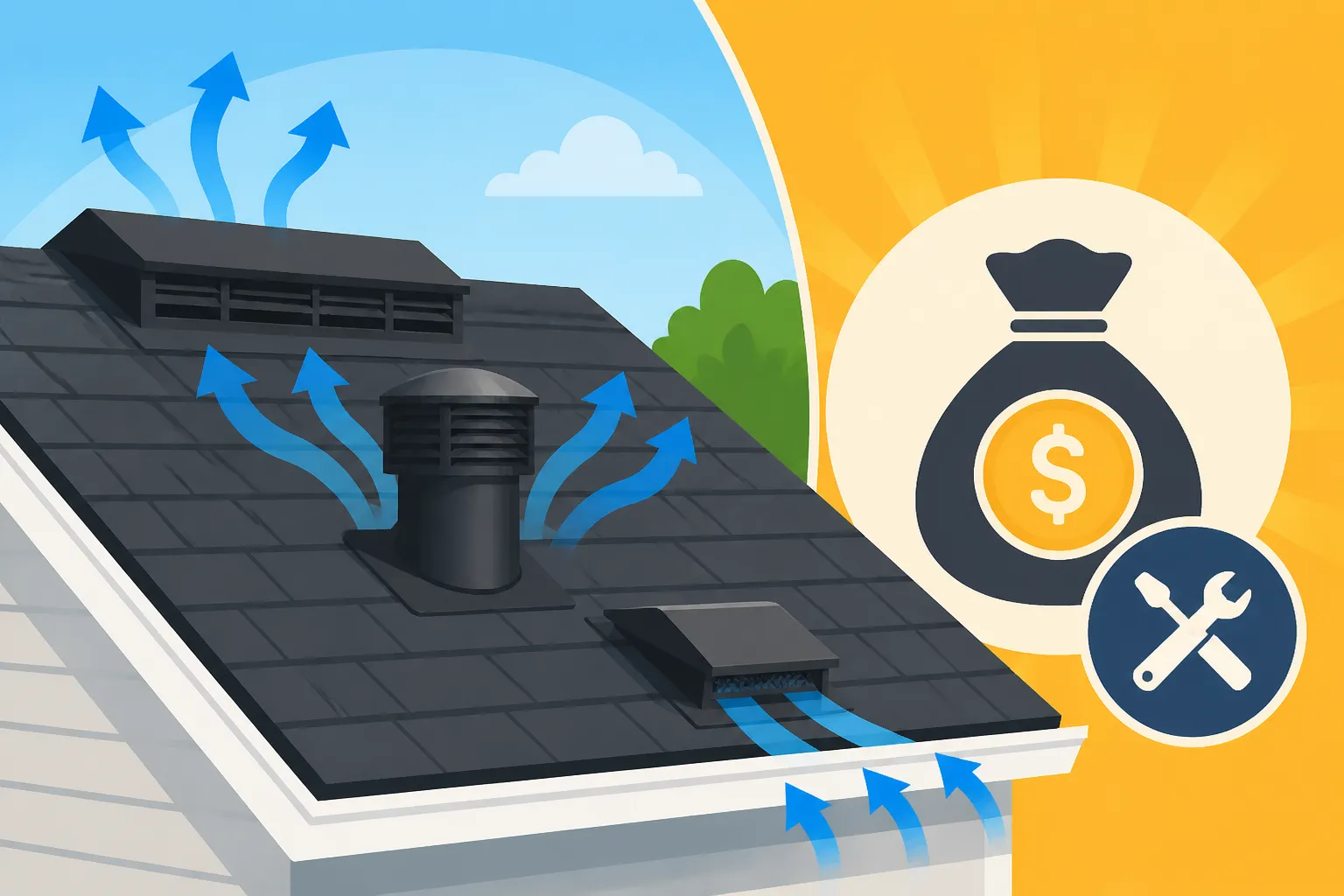
When it comes to upgrading your roof ventilation, it's not a one-size-fits-all solution. There are several types of vents, each with its own purpose and cost, designed to work together to create optimal airflow. A truly effective system often combines both intake (where air enters) and exhaust (where air leaves) vents.
Intake Ventilation: Soffit and Gable Vents
Intake vents are crucial because they're where the fresh, cooler air enters your attic. Without sufficient intake, your exhaust vents can't work properly to push out the stale air.
-
Soffit Vents: These are installed in the soffit panels under your roof's eaves. They are arguably the most effective intake vents because they introduce air at the lowest point of the attic, allowing it to naturally rise as it heats up, creating a natural convection current. They come in various styles, including continuous strip vents or individual circular vents.
- Cost: Installation costs for soffit vents can range from $3-$8 per linear foot for continuous vents or $15-$30 per individual vent, including labor and materials. If your home currently has no soffits or if they're blocked, the cost could be higher due to the need for fascia and soffit installation or clearing obstructions.
- Details: Many homes, especially older ones, either lack soffit vents entirely or have them painted over and blocked. A roofer will need to ensure proper airflow from the outside in, potentially cutting new openings or cleaning out old ones. The goal is to have an unobstructed path for air to enter the attic.
-
Gable Vents: These are typically rectangular or triangular vents installed on the gable ends of your house, high up near the peak. While they can provide some cross-ventilation, they are generally less effective than a balanced system of soffit and ridge vents because air may short-circuit, entering and exiting only through the gables, leaving other attic areas stagnant.
- Cost: Installing new gable vents might cost between $150-$400 per vent, depending on the size, material (vinyl, wood, aluminum), and complexity of cutting into the existing siding.
- Details: If you already have gable vents, a contractor might recommend sealing them if you're installing a ridge vent and soffit system to prevent air short-circuiting. This can seem counterintuitive but is vital for optimal whole-attic ventilation.
Exhaust Ventilation: Ridge, Box, and Turbine Vents
Exhaust vents are positioned at or near the highest point of your roof, allowing hot, moist air to escape.
-
Ridge Vents: These are long, continuous vents installed along the peak (ridge) of your roof. They are incredibly effective because they provide a uniform exhaust system along the entire length of the roof, working with soffit vents to create a consistent flow. They're often concealed by shingles, making them aesthetically pleasing.
- Cost: The cost for ridge vent installation typically ranges from $7-$15 per linear foot, including materials and labor. This can vary based on roof pitch and material. You can compare more details about the costs associated with a Cost of Ridge Vent Installation.
- Details: For a ridge vent to work optimally, a slot must be cut along the roof deck at the peak. This requires specialized tools and expertise to ensure it's done correctly without compromising the roof's structural integrity or weatherproofing.
-
Box Vents (Static Vents): Also known as low-profile or non-powered vents, these are individual, square-shaped vents installed at various points near the ridge of your roof. They rely solely on natural convection and wind pressure to exhaust air.
- Cost: Box vents are relatively inexpensive, costing between $30-$75 per vent for materials, plus installation labor, which can run $75-$150 per vent.
- Details: The main drawback is that they only ventilate the area immediately around them, potentially leaving dead air spots in other parts of the attic, especially on larger or more complex roofs. Multiple box vents are usually needed to adequately ventilate an attic, which can sometimes look cluttered.
-
Turbine Vents (Whirlybirds): These are those familiar spinning metal vents often seen on older homes. They use wind to create a vacuum effect, drawing hot air out of the attic.
- Cost: Turbine vents generally cost between $75-$150 per vent for materials, with installation adding another $75-$150 per vent.
- Details: Their effectiveness is highly dependent on wind, meaning they can be less reliable on calm days. They also have moving parts that can wear out or become noisy over time. For a deeper dive into the nuances of these exhaust options, check out our article on Ridge Vent vs Box Vent vs Turbine.
Powered and Solar-Powered Attic Fans
Sometimes, natural convection isn't enough, especially in very hot climates or for particularly large attics. This is where powered attic fans come in.
-
Electric Attic Fans: These fans are typically installed on the roof or in a gable wall and are hardwired into your home's electrical system. They have a thermostat that turns them on when the attic reaches a certain temperature (e.g., 95-105°F), actively pulling hot air out of the attic.
- Cost: An electric attic fan can cost anywhere from $200-$500 for the unit itself, with installation costs ranging from $250-$600, including electrical work.
- Details: While effective, they do consume electricity, which will add to your energy bill. The noise level can also be a factor for some homeowners, though modern fans are generally quieter.
-
Solar-Powered Attic Fans: These fans operate similarly to electric fans but are powered entirely by a small solar panel mounted on the unit itself. They run only when the sun is shining, but they use no grid electricity, making them an eco-friendly and cost-effective option in the long run.
- Cost: Solar attic fans are a bit pricier upfront, with units costing between $300-$800, and installation ranging from $200-$500.
- Details: The higher initial investment is offset by zero operating costs. They are a great choice for homeowners looking to reduce their carbon footprint and save on electricity. While the brand Modernize connects homeowners with vetted contractors for various home improvement projects, they could help you find a professional installer for these types of upgrades.
Here’s a quick overview of common ventilation types and their approximate installed costs:
| Ventilation Type | Description | Average Cost Per Unit/Linear Foot (Installed) | Key Benefit |
|---|---|---|---|
| Soffit Vents (Linear) | Continuous strip vents under eaves (intake) | $3 – $8 per linear foot | Efficient, uniform air intake |
| Soffit Vents (Individual) | Round vents under eaves (intake) | $15 – $30 per vent | Good for smaller, localized intake |
| Gable Vents | Decorative vents on gable walls (intake/exhaust) | $150 – $400 per vent | Aesthetic, some cross-ventilation |
| Ridge Vents | Continuous vent along roof peak (exhaust) | $7 – $15 per linear foot | Very efficient, concealed, uniform exhaust |
| Box Vents | Static, individual vents near roof peak (exhaust) | $105 – $225 per vent | Simple, inexpensive |
| Turbine Vents | Wind-driven spinning vents near roof peak (exhaust) | $150 – $300 per vent | Good with wind, no electricity |
| Electric Attic Fan | Thermostat-controlled, grid-powered fan (exhaust) | $450 – $1100 per unit | Active ventilation, highly effective |
| Solar Attic Fan | Thermostat-controlled, solar-powered fan (exhaust) | $500 – $1300 per unit | Active ventilation, no operating costs |
Note: Costs are estimates and can vary widely based on location, contractor, and specific product choices.
Factors Influencing the Cost of Ventilation Upgrades
Getting a precise estimate for roof ventilation upgrades can feel like a moving target because so many variables come into play. It’s not just about the type of vent; it’s also about the specifics of your home and who you hire.
Roof Size, Pitch, and Complexity
The overall size of your roof and attic space is a primary cost driver. A larger attic requires more ventilation to achieve adequate airflow, meaning more linear feet of ridge vent, more soffit vents, or more individual box/turbine vents. Similarly, the pitch, or steepness, of your roof plays a significant role in labor costs. A very steep roof (often indicated by a Steep Roof Cost Premium) requires more safety equipment, more time, and more specialized skills from roofers, which naturally increases labor expenses. This is why a simple ranch-style home might have lower installation costs than a multi-story house with a complex roofline, numerous valleys, dormers, or chimneys. Each of these architectural features adds to the intricacy of the job, requiring careful planning and execution for proper vent placement and sealing. For a general understanding of how these factors influence broader projects, you could look into What Drives Asphalt Roofing Costs Up or Down.
If your roof has multiple peaks or varying sections, installing a continuous ridge vent system might not be straightforward, potentially requiring a mix of different vent types or custom solutions. This complexity can extend the project timeline and, consequently, the labor charges. Even the current condition of your roof decking can be a factor; if the existing roof deck is damaged and needs repairs, for example, if there’s rotted wood from previous moisture issues, that’s an additional cost factor before any new vents are even installed.
Labor Rates and Regional Differences
Just like with any home improvement project, where you live significantly impacts the cost of labor. Roofing professionals' hourly rates vary widely from state to state and even within different cities in the same state. For instance, you might find that the Asphalt Roof Replacement Cost in California or New York is higher than in more rural areas of the Midwest due to higher costs of living and demand for skilled trades. Experienced and reputable roofing contractors who are certified by manufacturers (like GAF Master Elite or Owens Corning Platinum Preferred contractors) often charge a bit more, but they bring invaluable expertise and often back their work with stronger warranties.
The local climate can also influence labor costs. In regions prone to extreme weather conditions, such as areas with heavy snow or high winds, installations might require specific materials or techniques to meet stricter building codes, which can add to the labor complexity and cost. Furthermore, a contractor's reputation and availability factor in. A busy contractor with a strong track record might command a higher price, but that often translates to a higher quality installation, which is a critical consideration for a system designed to protect your entire home. It's always wise to get multiple quotes and ask detailed questions about labor practices when you're interviewing contractors. Modernize is a great platform to connect with reputable local contractors who understand these regional nuances.
Materials, Brand, and System Integration
The quality and brand of the ventilation components you choose will directly affect the overall cost. Just like with shingles, there are premium ventilation products that offer enhanced durability, better aesthetics, or superior performance. For example, some ridge vents are designed to be nearly invisible, blending seamlessly with your roofline, while others might be more conspicuous. The material of the vents themselves (e.g., plastic, aluminum, galvanized steel) also plays a role in their cost and longevity. Higher-quality materials tend to last longer and withstand harsh weather better, offering a better long-term return on investment despite a higher upfront price.
The concept of a "full roofing system" is also important here. Many manufacturers, like GAF or Owens Corning, offer comprehensive roofing systems that include not just shingles but also underlayment, flashing, and various ventilation components designed to work together synergistically. Opting for a complete system from a single manufacturer can sometimes qualify you for enhanced warranty coverage, but it also means adhering to their specific product lines and installation guidelines, which may influence costs. It's not just about adding a single vent; it's about integrating multiple components—such as ensuring your new ridge vent pairs effectively with existing or new Soffit and Fascia Explained—to create a balanced and efficient airflow system throughout your attic. This systematic approach ensures that both intake and exhaust are properly balanced, preventing issues like negative pressure or short-circuiting of airflow.
Is a Roof Ventilation Upgrade Worth the Investment?
When you’re staring at a quote for home improvements, it’s natural to question whether the investment will truly pay off. With roof ventilation upgrades, the answer is a resounding yes, and the benefits often extend far beyond the initial cost.
Long-Term Savings and Increased Home Value
One of the most immediate and tangible benefits of proper attic ventilation is the impact on your energy bills. During hot summers, a well-ventilated attic can significantly reduce the heat load on your air conditioning system. This isn't just a marginal difference; homeowners often report noticeable reductions in their cooling costs, sometimes by 10-15% or more, simply because their AC isn't fighting against a superheated attic. In colder months, proper ventilation helps prevent moisture buildup, which can preserve your insulation's effectiveness. Damp insulation loses its R-value, making your home harder to heat and increasing your energy consumption. By keeping insulation dry and fluffy, you maintain its performance, leading to more efficient heating.
Beyond utility savings, improved ventilation extends the life of your entire roof system. When shingles aren't subjected to extreme heat or moisture, they last longer, delaying the need for a costly Asphalt Roof Replacement Cost: Complete Breakdown. This preservation alone can save you thousands of dollars over the lifetime of your home. A healthy roof also translates to a healthier home structure, preventing issues like mold growth, wood rot, and structural damage in your attic. When it comes time to sell, a well-maintained roof with a modern, efficient ventilation system is a major selling point. It signals to potential buyers that the home has been cared for, often increasing its curb appeal and overall market value. Many real estate agents confirm that homeowners see a strong Roof Replacement ROI Explained when they invest in key components like ventilation.
Potential Rebates and Insurance Benefits
While direct rebates specifically for roof ventilation upgrades might not be as common as those for solar panels or energy-efficient windows, there are often indirect incentives that can help offset the cost. Many states and utility companies offer energy efficiency programs that could include or factor in overall home energy improvements, of which a proper ventilation system is a crucial part. It's always a good idea to check with your local energy provider or state government websites for any potential tax credits or rebate programs for energy-saving home upgrades. For instance, improving your home's energy performance through measures like attic ventilation can often qualify you for certain federal energy tax credits that aren't exclusively tied to specific product types.
Furthermore, proper ventilation can indirectly benefit your homeowner’s insurance. By extending the life of your roof and preventing common issues like premature shingle degradation or moisture-related damage, you reduce the likelihood of filing a claim. In some cases, a well-maintained, code-compliant roof with adequate ventilation might even be viewed favorably by insurance companies, potentially leading to better policy terms or, at the very least, avoiding penalties or increased premiums associated with an aging or poorly maintained roof. Some insurance carriers might even offer discounts for specific roof upgrades that enhance durability or protect against common perils, such as certain impact-resistant shingles that rely on proper installation and ventilation to perform as intended. Be sure to discuss your ventilation plans with your insurance agent to see if any such benefits apply to your specific policy and location. A platform like Modernize can also help you find contractors familiar with local building codes and insurance requirements, ensuring your upgrade meets standards for maximum benefit.
Disclaimer
Please remember that all costs provided in this article are estimates and can vary significantly based on your geographic location, the specific contractor you choose, the complexity of your roof, and the quality of materials selected. It is highly recommended to obtain multiple detailed quotes from licensed and insured roofing professionals before making any decisions.