Cost of a New Roof for a Garage
Dealing with a garage roof that's seen better days can feel like a small problem that quickly balloons into a big headache. You know it needs to be replaced, but you're probably wondering, "Is it going to cost as much as my whole house roof?" or "Can I even afford this right now?" It's a valid concern because even smaller projects like a garage roof can come with unexpected expenses. This guide is here to walk you through the realistic costs of getting a new asphalt shingle roof for your garage, helping you understand what drives the price and how to approach the project without breaking the bank.
Understanding Garage Roof Costs
When you're looking at replacing the roof on your garage, it’s easy to assume it’ll be a straightforward, inexpensive job. After all, it’s much smaller than your house, right? While generally true, there are still many intricate details and significant cost factors that play into the final price tag. Thinking of it as just a "mini" version of your home's roof is a good starting point, as many of the same principles apply.
Key Factors Influencing the Price Tag
Several elements will heavily sway the overall cost of putting a new asphalt shingle roof on your garage. It's not just about the size; it's about the entire scope of work, from start to finish. Understanding these factors beforehand can help you better interpret quotes and make informed decisions.
First and foremost is the size of your garage, which directly correlates to the square footage of the roof. A compact single-car garage will naturally require fewer materials and less labor than a sprawling three-car garage. However, the exact dimensions of your roof can sometimes be larger than the garage footprint itself due to overhangs. Next, consider the roof pitch, which is how steep your roof is. A very low-slope roof might require different materials and installation techniques than a moderately pitched roof, while a steeply pitched roof presents safety challenges for installers and often commands a higher labor cost. Installers need more time, specialized safety equipment, and sometimes more crew members, which can lead to a significant Steep Roof Cost Premium.
The type of asphalt shingle you choose is another massive factor. Are you opting for basic 3-tab shingles, or do you prefer the more durable and aesthetically pleasing architectural shingles? Perhaps you're even considering luxury or designer shingles for a truly upscale look. Each type comes with a different price point for materials and can also influence installation costs. Beyond the shingles, you have other material costs like underlayment, drip edge, flashing around any vents or skylights, and starter strips. Finally, labor costs vary significantly by region and depend on the complexity of the job. A complete tear-off of an old roof layer, especially if there are multiple layers or rotten decking, will add to the labor and disposal fees. Your geographic location, the local cost of living, and the demand for roofing services in your area will also influence the labor rates. For example, Asphalt Roof Replacement Cost in California might be considerably higher than in Asphalt Roof Replacement Cost in Ohio.
Why a Garage Roof Isn't Just a "Small" House Roof
While a garage roof shares many structural and material similarities with a house roof, there are often subtle differences that can impact the project and its cost. It's not always just a scaled-down version of a larger job, and understanding these nuances can help manage expectations.
One major distinction often lies in accessibility and complexity. Many detached garages are single-story structures, making access for roofers relatively easy compared to a multi-story home. This can sometimes translate to slightly lower labor costs or faster project completion. However, if your garage is tucked into a tight spot, has mature landscaping around it that needs protection, or is attached to your home with a complex roofline, these factors can increase the difficulty and, consequently, the cost. Another point of difference is the scale of the crew. While a large house roof might require a significant crew of 8-10 people, a smaller garage roof might only need 3-5 roofers, which can influence how efficiently the job is completed and the overall labor expenditure. This often means the project feels less disruptive and can be finished in a shorter timeframe, sometimes even in a single day for very small garages.
Additionally, homeowners sometimes consider a DIY approach for a garage roof, which is rarely an option for a full house replacement. While a DIY project might save on labor, it comes with significant risks in terms of safety, proper installation, and warranty validity. Professional roofers ensure the work adheres to local building codes, and manufacturer warranties often require installation by certified contractors. For instance, How Asphalt Shingles Are Installed: Step by Step clearly outlines the intricate process that requires expertise. Therefore, while the idea of doing it yourself to save money is tempting, it’s crucial to weigh the long-term benefits and peace of mind that comes with professional installation.
Breaking Down the Components of Your Garage Roof Estimate
When you receive a quote for your garage roof, it might look like a single, daunting number. However, it's actually a compilation of several distinct components. Breaking down these elements can help you understand where your money is going and identify areas where you might be able to adjust or save. It’s not just shingles; it’s a whole system working together.
Materials: Shingles, Underlayment, and More
The materials chosen for your garage roof will represent a significant portion of the total project cost. This isn't just about the shingles themselves, but also the essential underlying components that ensure your roof performs effectively and lasts for years. Investing in quality materials, even for a garage, is crucial for durability.
Let's start with the shingles, the most visible and often most debated material choice.
- 3-Tab Shingles: These are the most economical option, offering a flat, traditional look. They are usually rated for shorter lifespans (typically 15-20 years) and have lower wind resistance. Choosing 3-tab shingles for a garage can significantly reduce the 3-Tab Shingle Roof Cost.
- Architectural Shingles (Dimensional): These are the most popular choice for both homes and garages. They are thicker, offer a more textured, multi-dimensional appearance, and come with longer warranties (typically 25-30 years or more) and better wind resistance. This upgrade provides a much more robust and appealing roof. You can learn more about Architectural Shingle Roof Cost in detail.
- Designer or Luxury Shingles: These are the premium option, designed to mimic the look of natural slate or cedar shakes. They are the most durable, often offering 40-50 year or lifetime warranties, and provide superior aesthetics and performance. While they add considerable cost, they can dramatically enhance the curb appeal of your property.
Beyond the shingles, underlayment is a critical, unseen component. This layer, typically felt or synthetic, goes directly over your roof decking and provides an extra barrier against moisture. Synthetic underlayment, while more expensive, offers superior protection and tear resistance compared to traditional felt paper. Synthetic vs Felt Underlayment Cost explores this difference in depth. Additionally, ice and water shield is a self-adhering membrane often required by code in colder climates or recommended in vulnerable areas like valleys and eaves to prevent leaks from ice dams.
Other essential materials include drip edge, which protects the edges of your roof decking, and flashing, critical metal pieces installed around chimneys, skylights, vent pipes, and wall intersections to prevent water intrusion. Ridge caps, starter strips, and nails also contribute to the material costs. Each of these components plays a vital role in creating a watertight and long-lasting roof system, and skimping on them can lead to costly repairs down the line.
Labor and Installation Complexity
The labor portion of your garage roof estimate covers the expertise, effort, and time required by the roofing crew to remove your old roof and install the new one. This often accounts for 40-60% of the total project cost, and several factors can make it go up or down.
One of the primary labor-intensive tasks is the roof tear-off and disposal. If your garage roof has one or more existing layers of shingles, these will need to be removed and properly disposed of. This process, known as a Cost of Roof Tear-Off and Disposal, involves manual labor, equipment, and landfill fees. The more layers there are, the longer it takes, and the more waste needs to be hauled away, directly increasing labor costs. If during the tear-off, the roofers discover rotted or damaged roof decking, this will necessitate additional labor for Roof Decking Replacement Cost. This unforeseen issue can significantly extend the project timeline and increase the final bill, as the compromised sections must be replaced to provide a sound surface for the new roof.
The pitch or steepness of your garage roof also plays a critical role in labor costs. A low-slope roof is generally easier and quicker to work on, requiring less specialized equipment and fewer safety measures. However, a steep-pitch roof requires roofers to work more slowly and cautiously, often using harnesses and additional staging. This increased difficulty and risk directly translate to higher labor charges per square foot. The overall complexity of your garage roof design is another consideration. A simple gable roof (a single peak) is generally less expensive to roof than a garage with multiple dormers, hips, valleys, or skylights. Each of these features requires careful cutting, flashing, and sealing, adding intricate steps to the installation process and demanding more skilled labor.
Finally, regional labor rates will impact your costs. A roofing crew in a high-cost-of-living area like Seattle or Boston will naturally charge more per hour than a crew in a more rural, lower-cost area. The demand for roofers in your local market can also influence pricing; if a major storm has recently hit your area, labor rates might temporarily surge due to high demand. Finding a reputable contractor through services like Modernize can help ensure you're getting competitive and fair bids for the labor involved in your garage roofing project.
Average Cost Ranges for Common Garage Types
It's tough to give an exact figure without seeing your specific garage, but we can definitely talk in averages to give you a solid idea. The size of your garage is the biggest determinant here, along with the complexity of its roofline and the materials you choose. Let's break down some common garage sizes and what you might expect to pay.
Single-Car Garage Roof Costs
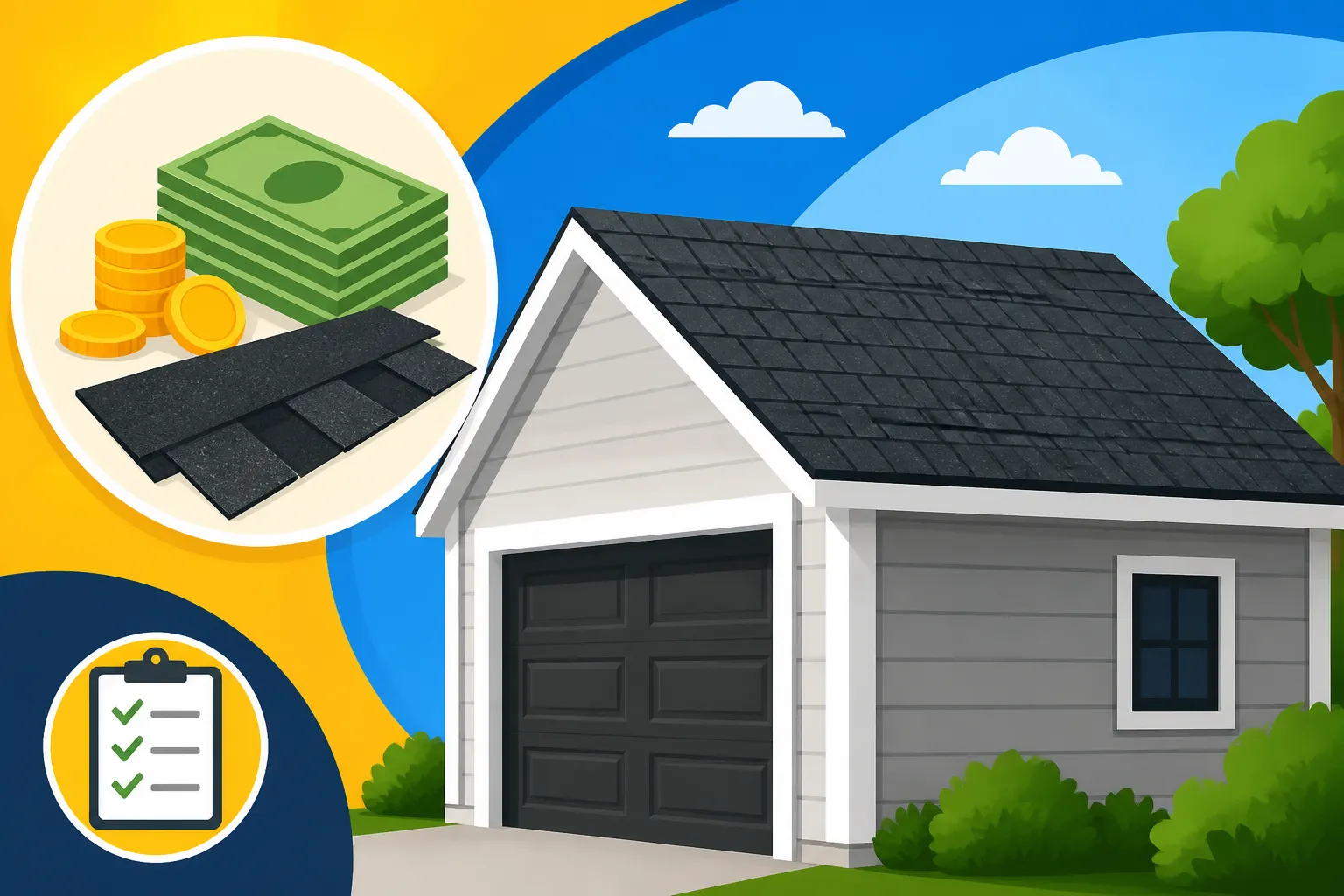
A single-car garage is often the most budget-friendly roofing project. These structures typically measure around 12×20 feet (240 sq ft) up to 14×24 feet (336 sq ft), meaning their roof area is also relatively small. For a basic single-car garage with a simple gable or shed roof and using standard architectural shingles, you can generally expect to pay somewhere in the range of $1,500 to $4,000.
If you're opting for basic 3-tab shingles and there's no decking damage or complex tear-off involved, you might find prices on the lower end, possibly even under $1,500 in some regions. This is especially true if the roof is very easy to access and has a low pitch. However, if you choose premium architectural shingles, need a full tear-off, and perhaps a few sheets of new decking, your cost will quickly climb towards the higher end of that range. For example, a 12×20 garage (240 sq ft) needs roughly 2.4 "squares" of roofing materials (a "square" is 100 sq ft). If materials cost $100-$200 per square and labor is $150-$300 per square, plus tear-off and other components, the numbers add up. Considering the total Roof Cost Per Square: What You'll Pay will give you a better idea. Keep in mind that detached garages, being stand-alone structures, generally have roofs that are easier to access and work on compared to an attached garage that might butt up against a two-story home.
Two-Car Garage Roof Costs
Two-car garages represent a step up in size and, consequently, cost. Common dimensions for a two-car garage are around 20×20 feet (400 sq ft) to 24×24 feet (576 sq ft). For these larger structures, especially if you're going with quality architectural asphalt shingles, you can typically anticipate a cost between $2,500 and $7,000.
Again, the factors of shingle choice, roof pitch, tear-off requirements, and any underlying repairs will significantly influence where your project lands within this range. If you have a larger two-car garage, say 24×24 feet, and opt for a higher-end architectural shingle like GAF Timberline HDZ, your material costs alone will be higher. The labor will also be more extensive due to the increased area and the additional time required for proper installation of a larger number of shingles. A two-car garage roof often involves 4-6 "squares" of roofing. Imagine the cumulative effect of a slightly steeper pitch or the need for a few sheets of Roof Decking Replacement Cost if water damage is present from the old roof. The economies of scale sometimes help a bit with labor on larger projects compared to very small ones, but the overall material quantity is the main driver. This kind of project is a perfect example where getting multiple estimates can truly make a difference, and services like Modernize can help you connect with qualified local contractors.
Detached vs. Attached Garage Considerations
The way your garage is connected (or not connected) to your main house can subtly but significantly impact the roofing costs and process. It's not just about the footprint; it's about the integration.
Detached garages are often simpler to re-roof. They typically have their own independent roofline, which means roofers have easy 360-degree access without worrying about damaging adjacent house walls or navigating complex transitions. This ease of access can sometimes reduce labor time and, therefore, cost. There's also less concern about matching existing house roof materials perfectly if you're not overly concerned with a uniform look across your property. For example, you might opt for more economical 3-tab shingles on a detached garage even if your house has architectural shingles, without it looking out of place. This autonomy can offer more flexibility in material choices and potentially lower costs.
On the other hand, attached garages present different challenges. Their roofs often tie directly into the main house roof, creating complex flashing details at the intersection points. This requires meticulous work to ensure a watertight seal, especially around shared walls or dormers. Roofers might need to match the existing house shingles precisely in color, style, and manufacturer if you want a seamless appearance, which can limit your options and potentially increase material costs if specialty shingles are required. Furthermore, working on an attached garage roof can be more challenging due to proximity to the house, making debris management and worker access trickier. If your attached garage has a second story or a room built above it, the roofing process will be even more similar to a full home re-roof, potentially involving more stringent code requirements and higher labor costs due to safety measures and complexity. In these scenarios, the Cost to Replace a Roof by House Size might be a more appropriate comparison point for the garage section.
Smart Ways to Save Money Without Cutting Corners
Replacing a garage roof is an investment, but that doesn't mean you can't be strategic about it. While it's tempting to go for the absolute cheapest option, true savings come from making smart choices that balance cost with quality and longevity. Nobody wants to re-roof their garage again in five years because they cut too many corners.
Getting Multiple Bids and Understanding Quotes
One of the most effective strategies for saving money on any roofing project, including your garage, is to gather several detailed bids from different contractors. Don't just settle for the first quote you receive. Aim for at least three to five estimates. This process allows you to compare not just the bottom-line price, but also the scope of work, the quality of materials proposed, and the professionalism of the contractors.
When reviewing bids, don't just glance at the final figure. Take the time to understand How to Read and Compare Roofing Estimates. Look for breakdowns of material costs, labor charges, tear-off and disposal fees, and any line items for things like permits, flashing, or decking repairs. A very low bid might indicate a contractor is cutting corners, using inferior materials, or not including essential parts of the job. Conversely, an extremely high bid might be overpriced. A good quote should clearly outline everything included, from the specific shingle brand and type (e.g., Owens Corning Duration or CertainTeed Landmark) to the warranty details. Asking for references and checking reviews for each contractor is also crucial. Services like Modernize can be incredibly helpful here, as they can connect you with pre-vetted local roofing contractors, making the process of collecting multiple competitive bids much smoother and less time-consuming. This ensures you're comparing apples to apples and not getting blindsided by hidden costs later.
The DIY Factor vs. Professional Installation
The idea of tackling a garage roof replacement yourself can be very appealing from a cost-saving perspective, as you'd eliminate labor costs entirely. For a very small, low-pitch detached garage, some homeowners with significant DIY experience might consider it. However, this decision comes with a substantial set of considerations and potential risks that need to be carefully weighed.
Firstly, safety is paramount. Roofing work is inherently dangerous, involving ladders, heights, and power tools. Falls are a leading cause of injury. A professional roofing crew has the proper safety equipment, training, and insurance to handle these risks. If you or someone helping you gets injured on your property, you could be liable. Secondly, proper installation is critical for the longevity and performance of your roof. Even a small error, such as improper nail placement, incorrect flashing around vents, or inadequate underlayment, can lead to leaks, premature shingle failure, and voided manufacturer warranties. How Shingles Are Nailed and Sealed is more complex than it looks! Professionals are trained in best practices and often hold certifications from shingle manufacturers (like GAF Master Elite or Owens Corning Platinum Preferred), which can unlock enhanced warranty coverage.
Thirdly, consider time and tools. Do you have the necessary tools (nail guns, air compressors, safety gear, a way to transport debris) or the time to dedicate several days or weekends to the project? Renting tools can add up, and delaying the project can leave your garage vulnerable to the elements. Lastly, warranty considerations are a big deal. Most reputable shingle manufacturers offer warranties that are contingent on professional installation by a certified contractor. If you DIY, you might only get a very basic material warranty, foregoing coverage for workmanship defects that a professional's warranty would cover. For all these reasons, while the immediate savings of DIY might look attractive, the long-term peace of mind, safety, and warranty protection offered by a professional installation often make it the more cost-effective choice in the long run, even for a garage. The Roofing Material Cost vs Labor Cost ratio often tips in favor of professional work when you factor in these critical aspects.
Timing Your Project Right
Believe it or not, the time of year you choose to replace your garage roof can actually influence the cost. Roofing is a seasonal business in many parts of the country, and understanding these cycles can help you secure better pricing or faster service.
Generally, the spring and fall are peak seasons for roofing contractors. The weather is mild, making it ideal for shingle installation, as the adhesive strips on asphalt shingles need warmth to properly seal. During these busy periods, contractors often have full schedules and less incentive to offer discounts. You might also experience longer wait times to get your project started. However, the shoulder seasons – late fall/early winter or late winter/early spring – can sometimes be more budget-friendly.
Winter (in climates where it's not excessively cold or snowy) and the off-peak periods of early spring and late fall can be excellent times to get a deal. Demand for roofers tends to be lower, which means contractors might be more willing to negotiate on price to keep their crews busy. They might offer discounts or be more flexible with scheduling. However, there are considerations: shingle sealing can be slower in colder temperatures, and extreme cold or heavy snow can halt projects. Similarly, mid-summer in very hot climates can also see a slight dip in demand as some homeowners defer projects due to the heat, offering another potential window for savings. Just be aware that Roof Installation in Hot Weather requires specific precautions. Discussing the ideal timing and potential pricing incentives with contractors during the quoting process, perhaps through a platform like Modernize, can give you an edge. They can advise you on local weather patterns and their impact on scheduling and pricing, helping you determine the Best Time of Year for Cheap Roofing.
Average Cost of a New Asphalt Shingle Roof for a Garage
To give you a clearer picture, here's a general breakdown of what you might expect for common garage sizes and shingle types. Remember, these are national averages and can fluctuate based on your specific location, contractor, and the unique challenges of your roof.
| Garage Size (Approx.) | Roof Area (Squares) | Shingle Type (Material & Install) | Estimated Cost Range | Key Considerations |
|---|---|---|---|---|
| Single-Car Garage | 2-3 squares | 3-Tab Asphalt Shingles | $1,500 – $2,500 | Most basic, shorter lifespan, lower wind resistance. Good for budget-conscious. |
| (12×20 ft – 14×24 ft) | Architectural Shingles | $2,000 – $4,000 | Popular choice, better durability & aesthetics. Excellent value. | |
| Designer/Luxury Shingles | $3,500 – $6,000+ | Premium look & longevity, significant upgrade in curb appeal. | ||
| Two-Car Garage | 4-6 squares | 3-Tab Asphalt Shingles | $2,500 – $4,000 | Entry-level for larger garages, often not recommended for long-term value. |
| (20×20 ft – 24×24 ft) | Architectural Shingles | $3,000 – $7,000 | Standard for most two-car garages, strong performance and appearance. | |
| Designer/Luxury Shingles | $6,000 – $10,000+ | High-end option, can match luxury home roofing. | ||
| Three-Car Garage | 7-10+ squares | 3-Tab Asphalt Shingles | $4,000 – $6,000 | Rarely used due to size, minimal long-term value. |
| (30×20 ft – 30×24 ft) | Architectural Shingles | $5,000 – $10,000 | Recommended standard, good blend of cost and quality for larger structures. | |
| Designer/Luxury Shingles | $9,000 – $15,000+ | Highest performance and visual impact. |
Important Notes:
- "Square": A roofing square is 100 square feet. Your garage roof will likely have a slightly larger square footage than the footprint of the garage itself due to overhangs.
- Tear-Off & Decking: These estimates generally include a basic tear-off of one layer of old shingles. If multiple layers exist, or if significant roof decking replacement is needed, expect higher costs.
- Pitch & Complexity: A very steep roof or one with multiple valleys, dormers, or skylights will increase labor costs, pushing you towards the higher end of these ranges.
- Location: Costs in high-cost-of-living areas (e.g., California, Northeast) will typically be higher than in lower-cost regions (e.g., Midwest, Southeast). You can explore specific regional costs, such as Asphalt Roof Replacement Cost in Florida for more localized insights.
- Additional Components: Costs for ice and water shield (if required), upgraded flashing, or new ventilation (like a Cost of Ridge Vent Installation) are often included but can also be add-ons.
This table gives you a starting point. Always get a detailed, written estimate from a qualified contractor to get an accurate price for your specific garage roof project.
Disclaimer
Please remember that the information provided in this article is intended for general informational purposes only. Roofing costs can vary significantly based on location, contractor, specific material choices, complexity of the job, and market conditions. We highly recommend consulting with multiple qualified, local roofing professionals to obtain accurate estimates and personalized advice for your specific project. Always verify contractor credentials, insurance, and references before making any hiring decisions.