What Causes Curling Shingles on a Roof
It's incredibly frustrating to look up at your roof and see those tell-tale signs: shingles starting to curl, warp, or even buckle. What might seem like a minor cosmetic issue can actually be a significant indicator that your roof's protective capabilities are compromised, leaving your home vulnerable to the elements. This guide is here to unravel the mystery of why asphalt shingles curl, explaining the underlying causes and what these common roof problems really mean for your home.
Understanding the Primary Causes of Shingle Curling
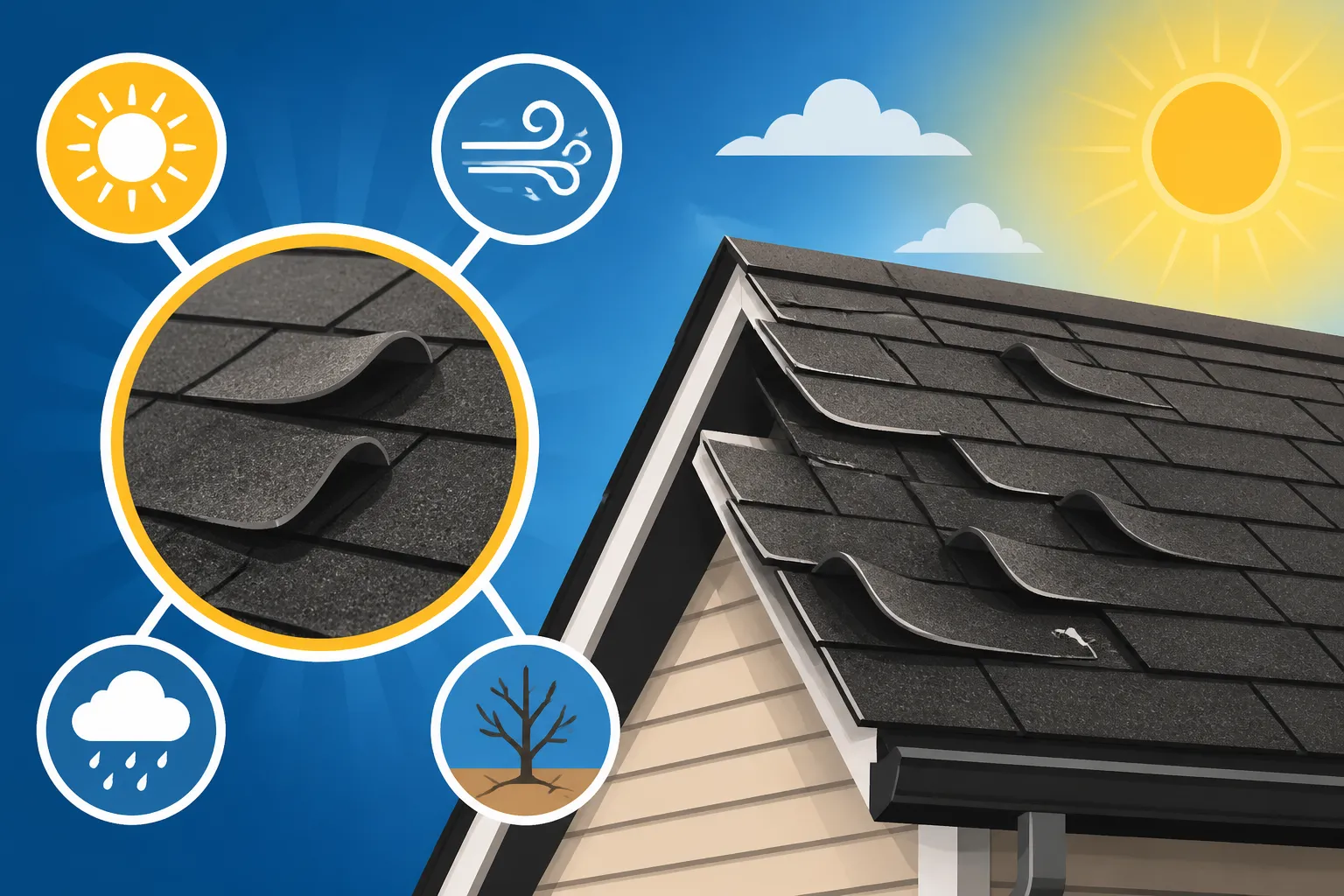
When you see those distinct upturned or downturned edges on your asphalt shingles, it’s not just an aesthetic imperfection. It’s often a symptom of underlying issues that can diminish your roof’s ability to shed water and protect your home. There are several key culprits behind this common roofing woe, each with its own set of contributing factors.
Intense Heat and Sun Exposure
Our roofs take a beating from the sun, day in and day out, and this relentless exposure is a major reason why shingles start to curl. Think of your roof as a giant sponge constantly absorbing and releasing energy. Over time, the sun's intense ultraviolet (UV) rays degrade the asphalt in the shingles, causing it to dry out and lose its elasticity. This isn't an overnight process; it's a gradual breakdown that typically occurs over many years.
When the asphalt begins to harden and shrink, the shingle's internal structure becomes less flexible. This loss of pliability makes it prone to warping. Imagine a piece of cardboard left out in the sun – it will dry out and curl. Asphalt shingles react similarly. The heat also causes the granules embedded in the shingle surface to loosen and fall off, further exposing the asphalt to direct UV radiation. Once these protective granules are gone, the shingle's vulnerability accelerates, leading to faster degradation and, yes, more curling. This is particularly true in regions like Arizona or Florida, where the sun beats down with relentless intensity for most of the year. You can learn more about what causes granule loss on a roof in a related article.
Insufficient Attic Ventilation
This cause might surprise some homeowners because it's not directly visible on the roof's surface, but poor attic ventilation is a silent killer for asphalt shingles. Your attic needs to breathe, allowing hot, moist air to escape. Without proper airflow, heat builds up dramatically in the attic space, especially during warmer months. This superheated air then cooks the underside of your roof deck, creating a significant temperature differential between the top and bottom surfaces of the shingles.
When the top surface of the shingle cools down at night, but the underside remains hot from trapped attic heat, it creates stress within the material. The constant expansion and contraction from these extreme temperature swings cause the shingles to distort and eventually curl. It's like having a miniature kiln baking your roof from below. An efficient ventilation system, often involving a combination of soffit and ridge vents, helps equalize these temperatures, allowing the roof deck and shingles to maintain a more consistent temperature, thus prolonging their life. Without it, you're essentially setting your roof up for premature failure and costly repairs down the line.
Manufacturing Defects and Material Quality
While most reputable manufacturers strive for high-quality products, occasionally, shingles can leave the factory with inherent defects that predispose them to curling. This isn't always common, but it can happen, especially with cheaper, lower-quality shingles that might not meet stringent industry standards. These defects could be related to the asphalt mix, the fiberglass mat, or the bonding agents used. If the fiberglass mat, which provides the shingle's strength and stability, isn't properly saturated with asphalt, or if the asphalt itself is of inferior quality or lacks the necessary plasticizers, the shingle will be weaker and more susceptible to environmental stresses.
For instance, some manufacturers might use less asphalt or a poorer quality blend to cut costs, making the shingle less flexible and more prone to cracking and curling when exposed to the elements. This becomes particularly evident during temperature fluctuations or intense UV exposure. When such defects are present, you might see curling appear relatively early in the roof's lifespan, long before it would normally be expected due to age. This is a tough one for homeowners to spot initially, but it often becomes clear when curling appears uniformly across a newer roof system.
Improper Installation Techniques
Even the highest quality shingles can fail prematurely if they're not installed correctly. Improper installation is a surprisingly common reason for curling and other roof problems. One of the most frequent culprits is incorrect nailing. If shingles are nailed too tightly, the nails can restrict the shingle's natural expansion and contraction with temperature changes. This creates stress points and causes the shingle to buckle or curl around the nail heads. Conversely, if nails are placed incorrectly – too high, too low, or too far from the sealing strip – they won't hold the shingle securely, allowing it to lift and warp.
Another installation error involves not accounting for thermal movement. Shingles need a little room to expand and contract. If they are butted too tightly against each other without adequate space, they can buckle and curl as they heat up and expand. Overlaps that are too small or too large can also contribute to improper sealing and lead to curling. A seasoned, reputable roofing contractor understands these nuances, ensuring that each shingle is installed precisely according to manufacturer specifications, which is crucial for the shingle's longevity and performance. If you're looking for a contractor, services like Modernize can help connect you with local professionals.
Natural Aging and Wear
Ultimately, even the best asphalt shingles have a finite lifespan, and as they approach their golden years, curling is one of the most visible signs of an aging roof. Over decades, the materials in the shingles simply break down. The asphalt oils that keep the shingle flexible and waterproof gradually evaporate, leaving the shingle brittle and dry. The fiberglass mat can become weak, and the bonding agents can lose their effectiveness.
This natural degradation process, compounded by years of sun exposure, temperature extremes, wind, and rain, causes the shingles to lose their structural integrity. They become less able to lay flat and more prone to warping. You might notice widespread curling across your entire roof, not just in isolated spots, which is a strong indicator that your roof is nearing the end of its serviceable life. This is a normal part of a roof's lifecycle, and if your roof is 20-25 years old, curling shingles are a clear signal that it's time to start thinking about a replacement. In such cases, understanding how long an asphalt roof lasts can help you plan.
The Distinct Types of Shingle Curling
You might think curling is just curling, but there are actually a couple of different ways asphalt shingles can warp, and understanding the distinction can offer clues about the underlying problem affecting your roof. While both types compromise your roof's integrity, their appearance can tell a different story about the root cause.
Cupping Shingles
Cupping is perhaps the most common form of shingle curling, characterized by the edges of the shingle turning upwards, creating a concave shape. Imagine holding a bowl with the open side facing up – that's roughly what a cupped shingle looks like on your roof. This upward curl typically happens because the bottom surface of the shingle is aging faster or experiencing more stress than the top surface.
The primary driver behind cupping is often insufficient attic ventilation or prolonged exposure to intense heat and UV rays. When the sun bakes the top of the shingle, and excessive heat radiates from a poorly ventilated attic onto the underside, the bottom layer of the shingle dries out and shrinks faster than the top. This uneven drying and contraction forces the edges to pull upwards. It’s like a drying leaf that curls inward on itself. Cupped shingles make your roof much more susceptible to wind damage, as the lifted edges act like tiny sails, catching the wind and potentially tearing off the roof. They also funnel water, rather than shedding it, which can lead to leaks if not addressed.
Clawing Shingles
Clawing is a slightly different manifestation of shingle curling, where the corners of the shingle turn downwards, while the middle portion remains relatively flat or even slightly elevated. This creates a "claw" like appearance on the roof, hence the name. Unlike cupping, which primarily affects the edges, clawing indicates a more widespread stiffening and drying out of the shingle material itself.
Clawing is most frequently associated with natural aging and wear, as well as manufacturing defects. As a shingle ages, the asphalt oils evaporate, and the material becomes brittle. The fiberglass mat inside the shingle loses its flexibility, and the shingle as a whole becomes more rigid. This rigidity, combined with environmental exposure, causes the corners to stiffen and pull downwards, creating that distinct clawed look. If you see clawing on a relatively new roof, it might point to a manufacturing defect where the shingle material wasn't uniformly flexible or durable. Clawing shingles are less effective at shedding water, as the downturned corners can trap moisture, and they also indicate a significantly compromised roof system that is likely nearing the end of its functional life.
Here's a quick comparison of the two types:
| Feature | Cupping Shingles | Clawing Shingles |
|---|---|---|
| Appearance | Edges curl upwards, center is flat/depressed | Corners curl downwards, center is slightly raised |
| Shape | Concave, like a bowl facing up | Convex, like a claw reaching down |
| Primary Causes | Poor attic ventilation, intense heat/UV exposure | Natural aging, manufacturing defects |
| Shingle Part | Uneven drying/shrinking of bottom surface | Widespread stiffening/brittleness of entire shingle |
| Implication | Increased wind vulnerability, poor water shedding | Sign of widespread material degradation, end-of-life |
| Typical Age Range | Can appear early with ventilation issues, or later | Typically seen on older roofs, or defective newer ones |
The Impact of Curling Shingles on Your Home
Seeing curling shingles on your roof isn't just an eyesore; it's a glaring red flag that your home's primary defense against the elements is weakening. The implications go far beyond aesthetics, touching on everything from structural integrity to your utility bills. Ignoring curling shingles is akin to ignoring a slow leak in a boat – eventually, you're going to have a bigger problem on your hands.
Increased Vulnerability to Weather Damage
The most immediate and critical impact of curling shingles is the significant reduction in your roof's ability to protect your home from the elements. Asphalt shingles are designed to lay flat, creating a continuous, overlapping barrier that allows water to flow unimpeded off your roof and into your gutters. When shingles curl, this protective seal is broken.
- Wind Damage: Cupped shingles, with their lifted edges, become prime targets for wind. Even moderate gusts can catch these elevated edges, lifting them further, tearing them off entirely, or even peeling back entire sections of your roof. This exposes the underlayment and roof deck to direct wind and rain, accelerating damage.
- Water Infiltration: Curling creates gaps and channels where water can collect instead of running off. Rainwater, especially during heavy downpours, can easily seep under the lifted edges, bypassing the shingle's protective function. This water can then saturate the underlayment, rot the roof deck, and eventually lead to leaks inside your attic and living spaces. Persistent moisture can also foster mold and mildew growth in your attic, posing health risks and further damaging the roof structure. You might find yourself needing a roof repair vs replacement decision much sooner than anticipated.
- Hail and Debris: A flat, healthy shingle is more resilient against impacts from hail and falling debris. Curling shingles, being brittle and compromised, are far more susceptible to cracking, splitting, or breaking apart when struck by hailstones or tree branches. The weakened material simply cannot absorb impact as effectively as a new, flexible shingle.
Decreased Curb Appeal and Home Value
While the structural implications are paramount, the visual impact of curling shingles is also undeniable. A roof with warped, uneven shingles looks neglected and can significantly detract from your home's curb appeal. If you've ever driven through a neighborhood and noticed a house with a visibly distressed roof, you know the impression it leaves. This is more than just superficial; it can have tangible financial consequences.
- Reduced Resale Value: If you're planning to sell your home, curling shingles can be a major deterrent for potential buyers. A compromised roof signals deferred maintenance and impending, expensive repairs. Buyers will often factor in the cost of a new roof when making an offer, or they might simply be turned off by the visible disrepair. This can lead to lower offers or a longer time on the market.
- Negative First Impressions: For existing homeowners, a curling roof can impact how your home is perceived in the neighborhood. It projects an image of disrepair, which can subtly affect your pride of homeownership and even influence property values in your immediate area. First impressions matter, and your roof is one of the first things people notice.
Higher Energy Bills and Shortened Roof Lifespan
The long-term effects of curling shingles also hit your wallet through higher energy costs and the need for premature roof replacement. These seemingly small problems compound over time, leading to significant expenses.
- Inefficient Insulation: As shingles curl and lose their integrity, they can become less effective at insulating your home. Gaps created by warped shingles can allow more heat transfer, meaning your HVAC system has to work harder to maintain a comfortable indoor temperature. If curling is caused by poor attic ventilation, the superheated attic space will bleed heat into your living areas in summer and draw warmth out in winter, directly leading to increased heating and cooling costs. This often signals a need to check your roof ventilation system, which is a key component of your overall roof anatomy.
- Premature Roof Replacement: Curling shingles are a clear sign that your roof system is failing. Left unaddressed, the issues will only worsen, leading to leaks, rot, and widespread damage that cannot be simply repaired. What might have been a minor repair opportunity can quickly escalate into the necessity for a full roof replacement. This can mean spending tens of thousands of dollars years before you should have to, wiping out any potential savings you might have hoped for by delaying action. Understanding the signs you need a new roof is crucial here, as is knowing how a roof replacement works.
Effective Solutions and Prevention Strategies
While seeing curling shingles can be alarming, it doesn't always mean you need an immediate full roof replacement. The right course of action depends heavily on the extent of the damage, the age of your roof, and the underlying cause. However, there are certainly steps you can take to address the issue and prevent it from recurring.
Ensuring Proper Attic Ventilation
As we've discussed, poor attic ventilation is a major contributor to shingle curling, especially cupping. Addressing this issue can not only extend the life of your existing roof but also improve your home's energy efficiency. The goal of proper ventilation is to create a continuous airflow: cool, fresh air enters through soffit vents (located under the eaves) and warm, moist air exits through exhaust vents (like ridge vents or box vents) located near the peak of the roof.
- Assess Existing Ventilation: Start by inspecting your current attic ventilation system. Do you have adequate intake and exhaust? Is it blocked by insulation, debris, or paint? Sometimes, simply clearing obstructions can significantly improve airflow. You might have soffit vents but no clear path for air to move into the attic space if the insulation is too thick.
- Upgrade When Necessary: If your current system is inadequate, consider upgrading. Installing a continuous ridge vent along the peak of your roof, combined with sufficient soffit vents, provides the most effective natural convection. In some cases, powered attic fans (either electric or solar-powered) may be beneficial, though they should always work in conjunction with passive ventilation. A qualified roofing professional can perform a ventilation assessment and recommend the best solution for your home, helping to prevent future temperature-related curling.
Professional Inspection and Targeted Repairs
For minor or localized curling, particularly on a younger roof, a professional inspection is the first crucial step. A reputable roofer can pinpoint the exact cause of the curling and determine if a repair is feasible. They will look for signs of improper nailing, localized heat damage, or potential manufacturing defects.
- Repairing Individual Shingles: If only a few shingles are curled due to localized issues, a contractor might be able to carefully flatten them, re-adhere them with roofing cement, or replace the individual damaged shingles. This is usually only effective if the shingles aren't too brittle and if the curling hasn't caused significant cracking or granule loss. Matching new shingles to an older, faded roof can be a challenge, but a skilled roofer can often find a close match.
- Addressing Installation Errors: If the curling is due to improper nailing, a roofer might be able to remove and reinstall shingles with correct nailing techniques. However, if the shingles are already stiff and brittle, attempting to remove and re-nail them might cause them to crack or break. This type of repair is more viable on newer roofs where the shingles still have some flexibility. Always ensure any repair work comes with a workmanship warranty. When seeking out professionals for such inspections, you might use services like Modernize to find qualified local contractors.
Knowing When to Replace Your Roof
There comes a point when repairs are no longer cost-effective or practical, and a full roof replacement becomes the only sensible option. Curling shingles, especially when widespread and accompanied by other signs of aging, are often a strong indicator that your roof is nearing the end of its functional life.
- Age of the Roof: If your asphalt shingle roof is 20-25 years old or more, and you're seeing significant curling, it's highly probable that the entire roof system is deteriorating. While modern architectural shingles can last longer, traditional 3-tab shingles typically have a shorter lifespan. In this scenario, investing in repairs is often throwing good money after bad.
- Extent of Damage: If curling is widespread across multiple slopes of your roof, or if it's combined with other issues like significant granule loss, cracking, blistering, or active leaks, a full replacement is almost certainly warranted. These are all signs of a roof that can no longer effectively protect your home. It’s better to be proactive and plan for a replacement rather than waiting for a major leak or structural damage to occur.
- Cost-Benefit Analysis: Get a few comprehensive roofing estimates to understand the full scope of the work. If the cost of extensive repairs approaches a significant percentage of a new roof's cost, replacement is often the more economical long-term decision. A new roof offers peace of mind, improved aesthetics, enhanced home value, and a fresh warranty that will protect your investment for decades to come. Don't hesitate to consult resources like how to get roofing quotes and compare them to ensure you're making an informed decision.
Disclaimer
Please remember that this article is intended for informational purposes only and should not be considered professional advice. Always consult with a qualified and licensed roofing contractor for specific recommendations regarding your home's roof. Roofing work can be dangerous and should be performed by experienced professionals.