How to Find a Good Roofer in Michigan
Finding a good roofer in Michigan can feel like a daunting task, especially when you're facing a leaky ceiling or a roof battered by one of our notorious Midwestern winters. You want someone reliable, trustworthy, and knowledgeable about the unique challenges our state's weather throws at us, but sorting through all the options can be overwhelming. This guide is here to walk you through exactly how to find a reputable, high-quality roofing contractor in Michigan, ensuring your home is protected for years to come.
Navigating Michigan's Unique Roofing Environment
Michigan weather is a beast, plain and simple. From the brutal cold and heavy snowfalls that lead to dreaded ice dams, to the sudden summer thunderstorms and occasional hail, your roof takes a beating. This isn't just about picking a contractor; it's about finding someone who intimately understands these local conditions and knows how to build a roof that can withstand them.
The Impact of Michigan Weather on Your Roof
Think about it: a roof in Arizona faces vastly different stresses than one in Michigan. Here in the Great Lakes State, we deal with extreme temperature fluctuations that cause materials to expand and contract repeatedly. This constant movement can wear down shingles faster than in more temperate climates. Then there's the sheer weight of snow, especially in areas like the Upper Peninsula or along the Lake Michigan shoreline, where lake-effect snow piles up. This weight tests the structural integrity of your roof, and if your attic isn't properly ventilated, you're looking at prime conditions for ice dam formation, which can force water under your shingles and into your home. A good roofer in Michigan won't just throw up shingles; they'll consider the entire system, including proper ventilation and ice and water shield installation, which are critical components for our climate.
Understanding Michigan's Contractor Regulations and Permits
One of the first things many homeowners wonder about is licensing. Does Michigan require roofers to be licensed? This can be a bit confusing. In Michigan, individual roofers typically don't hold a specific "roofing license" at the state level. However, any contractor performing residential building work that costs over $600, including roofing, must hold a residential builder or maintenance and alteration (M&A) contractor license issued by the Michigan Department of Licensing and Regulatory Affairs (LARA). This is a critical distinction. A legitimate roofing company will have this license. This ensures they've met certain educational and experience requirements and are accountable to the state. Always verify this license with LARA's online database.
Beyond state licensing, local municipalities often have their own permit requirements for roof replacement projects. For instance, if you live in Grand Rapids, you'll need a building permit for a roof tear-off and replacement. The same goes for cities like Ann Arbor, Livonia, or Sterling Heights. These permits ensure that the work meets local building codes, which are in place for your safety and to protect your investment. A professional contractor will handle the permit application process for you, including any necessary inspections. You should always ask your prospective roofer about their process for securing permits and ensuring code compliance. Skipping this step can lead to fines, problems with insurance, or issues when you eventually sell your home.
Essential Qualities of a Reputable Michigan Roofer
When you're entrusting someone with your home's most important protector, you can't just pick the first name you see. A truly good Michigan roofer will stand out from the crowd through a combination of credentials, experience, and customer care.
Proper Licensing, Insurance, and Manufacturer Certifications
As we discussed, a valid residential builder's license in Michigan is non-negotiable for any contractor working on your roof. This isn't just a piece of paper; it signifies a level of accountability and professional standard. Beyond that, proper insurance is absolutely paramount. Your roofer should carry both general liability insurance, which covers damage to your property or a neighbor's property during the job, and worker's compensation insurance, which protects their employees if they get injured on your site. If a roofer doesn't have worker's comp and one of their crew gets hurt on your property, you could potentially be held liable. Always ask for current certificates of insurance and call the insurance providers directly to verify their validity. You wouldn't believe how many folks skip this vital step only to find themselves in a pickle later. For a deeper dive into why this is so important, check out our article on Licensed and Insured Roofers: Why It Matters.
Many top-tier roofing companies also hold certifications from major shingle manufacturers like GAF, Owens Corning, or CertainTeed. These certifications, such as GAF Master Elite or Owens Corning Platinum Preferred, mean the contractor has met stringent requirements set by the manufacturer for training, quality of work, and financial stability. It also often qualifies them to offer enhanced warranties that go beyond the standard product warranty, protecting both the materials and the workmanship for a longer period. For example, a GAF Master Elite contractor can offer their Golden Pledge Warranty, which is one of the best in the industry. These certifications are a strong indicator of a contractor's commitment to quality and professionalism.
Proven Local Experience and Strong Reputation
Hiring a roofer who is deeply rooted in the Michigan community offers several advantages. They're more familiar with local building codes, weather patterns, and even common roofing issues specific to our region, like persistent moss growth in shaded areas or storm damage from particular wind directions. A local contractor also has a reputation to uphold within the community, which often translates to higher quality work and better customer service. They’re not going to pack up and disappear after a storm; they’re here to stay.
A strong reputation isn't built overnight, and it's certainly not built on flimsy work. You can get a good sense of a company's standing by checking online reviews on platforms like Google, Yelp, and the Better Business Bureau. Don't just look at the star rating; read through the comments. Are there recurring themes about professionalism, communication, quality, or cleanup? Look for a balance of positive experiences and how the company responds to any negative feedback. It's also a great idea to ask for local references—customers they've worked with recently in your area. A truly reputable company will be happy to provide them. This process of vetting reviews and references is crucial, and you can learn more about it in our guide on How to Check Roofer Reviews and References.
Your Step-by-Step Process to Vet a Michigan Roofer
Finding the right contractor isn't a passive activity; it requires a bit of detective work on your part. But trust me, a little effort upfront can save you a world of headaches and expense down the line.
Gathering and Comparing Multiple Estimates
Don't ever settle for just one bid. Seriously, I can't stress this enough. You need at least three, and ideally five, detailed estimates from different roofing companies. This allows you to compare not just the bottom-line price, but also the scope of work, the materials proposed, warranty options, and timelines. When you're gathering these estimates, make sure each contractor performs a thorough inspection of your existing roof and attic. A reputable company won't just eyeball it from the ground. They'll get up there, take measurements, check for deck damage, assess ventilation, and note any chimney or skylight flashing issues.
When receiving estimates, pay close attention to the details. Is one estimate significantly lower than the others? This could be a red flag, potentially indicating cut corners or hidden costs that will pop up later. Conversely, a much higher estimate might not always mean better quality; it could just be an inflated price. Use services like Modernize to help connect you with pre-screened local contractors, which can streamline the process of getting multiple quotes. This way, you’re not just pulling names out of a hat. For more tips on how to efficiently get bids, check out our post, How to Get Multiple Roofing Estimates Fast.
Demanding a Detailed Contract and Understanding Warranties
Once you have a few estimates, the next crucial step is to insist on a comprehensive, written contract before any work begins. This contract should be a roadmap of the entire project, leaving no room for ambiguity. It should clearly outline:
- Scope of Work: Exactly what will be done, including tear-off, any necessary decking replacement, underlayment, shingle type and color, ventilation, flashing, and cleanup.
- Materials: Specific brands, models, and quantities of shingles, underlayment, ice and water shield, and other components. Don't let them be vague.
- Timeline: Start and completion dates.
- Payment Schedule: Clearly defined payment milestones, usually with an initial deposit (rarely more than 10-20%), and subsequent payments tied to project completion phases. Never pay the full amount upfront.
- Permits: Confirmation that the contractor will secure all necessary local permits.
- Insurance Information: Verification of their liability and worker's compensation insurance.
- Warranties: Details on both the manufacturer's warranty for materials and the contractor's warranty for workmanship.
Speaking of warranties, these are incredibly important for your peace of mind. A typical asphalt shingle roof will come with a manufacturer's limited lifetime warranty on the shingles themselves, but often, the most important warranty is the one covering the workmanship. Even the best shingles won't perform if they're installed incorrectly. Look for a contractor who offers at least a 5-10 year workmanship warranty. As mentioned before, manufacturer certifications often unlock enhanced, longer-lasting warranties that cover both materials and labor. Our article, What to Include in a Roofing Contract, offers an even deeper dive into this topic.
Evaluating Communication and Professionalism
From your very first contact, pay close attention to how a roofing company communicates. Do they answer your calls or emails promptly? Are they punctual for appointments? Do they explain things clearly and patiently answer all your questions, without making you feel rushed or stupid? These are all indicators of their professionalism and how they'll likely treat you once the job starts. A contractor who is vague, uncommunicative, or seems annoyed by your questions is probably not the right fit. You want a team that shows respect for your time and property, and that starts with clear, consistent communication. This will be your partner throughout a significant home improvement project, so choose someone you feel comfortable talking to.
Avoiding Common Pitfalls and Roofing Scams in Michigan
Unfortunately, the roofing industry, like any other, has its share of less-than-reputable players. In Michigan, with our challenging weather, these bad actors often appear right when homeowners are most vulnerable.
Beware of "Storm Chasers" and Unsolicited Offers
After a major storm—whether it's heavy hail in southeast Michigan or strong winds ripping through the northern parts of the state—be extra vigilant. This is prime time for "storm chasers," out-of-state contractors who descend on affected areas, often going door-to-door, promising quick fixes or free inspections. While not all out-of-state contractors are bad, many storm chasers are here today, gone tomorrow. They might do shoddy work, take your money, and then vanish, leaving you with a compromised roof and no recourse when issues arise.
My best advice? Be skeptical of anyone knocking on your door unsolicited, especially if they pressure you to sign a contract on the spot or claim to be working with your insurance company without your prior consent. Always research any company that approaches you this way. Verify their local presence, check their Michigan residential builder's license, and ask for local references. Don't be swayed by high-pressure sales tactics. For more detailed warnings, read our guide on Storm Chaser Roofers: How to Spot Them.
Red Flags: Large Upfront Payments and Pressure Tactics
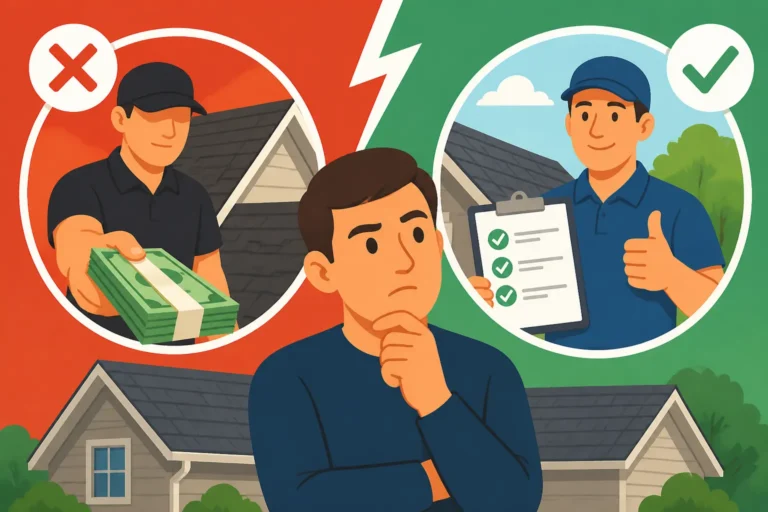
A common red flag is a contractor demanding a large portion, or even the entire payment, upfront before any work has even begun. While a reasonable deposit (typically 10-20%) is standard to cover initial material costs, anything more should give you pause. Legitimate contractors usually structure payments around project milestones, like once materials are delivered, after tear-off, or upon completion of specific phases.
Another major red flag is intense pressure to sign a contract immediately. "This price is only good today!" or "We have a cancellation, so we can start tomorrow if you sign now!" are classic high-pressure tactics. Take your time. Get multiple bids. Do your research. A trustworthy contractor will give you time to review the estimate and contract thoroughly and make an informed decision without feeling rushed. This is a significant investment in your home, and you deserve to feel completely confident in your choice. If you hear someone asking for large upfront payments, that's one of the biggest Roofing Red Flag: Asking For Full Payment Upfront that homeowners should look out for.
Verifying Contractor Credentials with Michigan LARA
Remember that state-issued residential builder's license? You can—and absolutely should—verify it yourself. The Michigan Department of Licensing and Regulatory Affairs (LARA) maintains an online database where you can search for a contractor by name or license number. This will confirm if their license is active and if there have been any disciplinary actions against them. This simple check takes minutes but can save you countless headaches. If a contractor can't or won't provide their license number, or if it doesn't check out on the LARA site, walk away.
Here's a quick comparison of what separates a good Michigan roofer from a risky one:
| Feature | Reputable Michigan Roofer | Risky Contractor |
|---|---|---|
| State License | Active Residential Builder's license (verified via LARA) | No license, expired license, or cannot provide proof |
| Insurance | Provides current Certificates for General Liability & Worker's Comp | Claims to be insured but can't provide proof, or has none |
| Local Experience | Established presence, references in Michigan communities | Unknown, out-of-state, no local track record |
| Estimates | Detailed, itemized, fair pricing, considers Michigan climate | Vague, low-ball or excessively high, pressure to sign |
| Contract | Comprehensive, written, clear scope of work, payment terms | Verbal agreements, vague language, missing details |
| Payment Terms | Small deposit (10-20%), milestone payments | Demands large upfront payment or full payment upfront |
| References/Reviews | Happy to provide local references, strong online reputation | No references, poor reviews, or only generic testimonials |
| Communication | Prompt, clear, professional, answers all questions | Slow to respond, vague, high-pressure, pushy |
| Manufacturer Certs | Often holds certifications (GAF, OC, CertainTeed) | No manufacturer certifications |
By taking the time to thoroughly vet your options, you'll be well on your way to finding a good roofer in Michigan who will install a high-quality, durable roof that stands up to whatever our beautiful but challenging state throws at it. Don't rush, do your homework, and your home will thank you for it!
Disclaimer
Please remember that this guide provides general advice. Roofing regulations, costs, and best practices can vary based on your specific location within Michigan and the unique characteristics of your home. Always consult with multiple qualified, local roofing professionals and your local building department to get the most accurate information for your project.